


Trouver des essentiels durables pour la maison avec un budget limité : guide 2026
Table des matières
- Pourquoi les articles ménagers bon marché échouent : le coût réel des « bonnes affaires »
- Comment acheter des articles ménagers avec un budget limité sans acheter de la camelote
- Articles ménagers essentiels pour les primo-accédants : que privilégier
- Les meilleurs ustensiles de cuisine abordables qui survivent vraiment à un usage quotidien
-
Améliorations de nettoyage intelligentes : patins et têtes de balai réutilisables qui permettent d'économiser
- Le coût réel des systèmes de nettoyage jetables
- Choisir le bon système de balai pour vos sols
- Prolonger la durée de vie de vos têtes de balai
- Alternatives réutilisables pour chaque tâche ménagère
- Des substitutions de produits spécifiques qui valent le coup
- Une routine d'entretien simple pour maximiser la longévité
- Bases de la science des matériaux : comment repérer la durabilité du plastique, du bois et du silicone
- Le calendrier des soldes saisonnières : quand acheter ses essentiels ménagers pour un maximum d'économies
- Conclusion : aménagez votre maison lentement avec des pièces durables
- Questions fréquemment posées
Dernière mise à jour : 9 septembre 2026
Pourquoi les articles ménagers bon marché échouent : le coût réel des « bonnes affaires »
L'option la moins chère n'est presque jamais la plus rentable. Lorsqu'un bac de rangement en plastique fragile se fissure en six mois, vous financez un cycle de remplacement sans fin. Trouver des essentiels ménagers durables avec un budget limité ne dépend pas du prix le plus bas affiché, mais de ce que vous payez par année d'utilisation.
Ce guide de Dream Deal Shop se concentre sur des choix pratiques et économiques qui offrent une réelle valeur à long terme plutôt que de la camelote jetable.
Les articles bon marché lâchent au pire moment : une poignée de tiroir casse, une tête de balai se désintègre en plein nettoyage ou un couvercle de rangement se déforme. Vous rachetez alors le même article de mauvaise qualité et le cycle recommence. Adoptez une mentalité axée sur la longévité des produits et leur utilité polyvalente.

Comment acheter des articles ménagers avec un budget limité sans acheter de la camelote
Acheter intelligemment signifie évaluer l'intégrité des matériaux avant de payer. Une erreur courante consiste à supposer que tous les plastiques se valent. Recherchez des matériaux plus épais et de qualité alimentaire comme le PET ou le PP pour le rangement de cuisine, car ils résistent mieux aux fissures et aux changements de température que les acryliques fins et cassants.

Posez-vous trois questions avant tout achat :
- Cet article peut-il être réparé ou entretenu, ou est-il conçu pour être jeté ?
- Le matériau résiste-t-il à l'usure spécifique de son utilisation prévue ?
- S'agit-il d'un article de base que j'utiliserai chaque semaine, ou d'une tendance passagère ?
L'occasion et le surcyclage offrent également d'excellentes pistes pour obtenir des essentiels durables. Les meubles en bois massif, les ustensiles en fonte et les outils de qualité se trouvent souvent dans les friperies pour une fraction de leur prix de vente. Une petite réparation ou un coup de peinture peut transformer une pièce usée en une pièce maîtresse fonctionnelle, soutenant à la fois un mode de vie durable et votre portefeuille.
Articles ménagers essentiels pour les primo-accédants : que privilégier
Lors de l'emménagement dans un nouvel espace, résistez à l'envie de remplir chaque pièce immédiatement. Donnez la priorité aux articles qui subissent le trafic quotidien le plus intense : préparation culinaire, entretien du nettoyage et organisation de base.
Une liste de départ pratique comprend un bon couteau, une planche à découper, des ustensiles de cuisine à fond épais, des contenants hermétiques et un système de balai fiable. Pour le reste, n'achetez quelque chose que lorsque vous en avez un besoin spécifique, pas parce qu'une promotion semble trop belle pour être ignorée.
Les meilleurs ustensiles de cuisine abordables qui survivent vraiment à un usage quotidien
La cuisine est l'endroit où les articles ménagers bon marché disparaissent rapidement. Les ustensiles tombent, les couvercles fondent, et les récipients se tachent ou se fissurent. Pour constituer un ensemble d'essentiels de cuisine durables qui survit à la cuisine quotidienne, vous devez privilégier des matériaux qui tolèrent la chaleur, l'humidité et les lavages répétés.
Couteaux : le seul outil que vous ne devriez jamais acheter jetable
Le couteau est l'outil le plus utilisé dans la plupart des cuisines, et pourtant, c'est là que les acheteurs font souvent leur première erreur. Un bloc de couteaux à 15 $ semble être une affaire, mais ces lames sont découpées dans de l'acier fin qui s'émousse en quelques semaines et ne peut pas être affûté efficacement, créant un outil dangereux qui glisse au lieu de couper.
Recherchez plutôt un couteau de chef avec une soie pleine (le métal parcourt toute la longueur du manche) pour éviter que la lame ne se sépare. L'acier inoxydable à haute teneur en carbone offre un bon équilibre entre la tenue du tranchant et la résistance à la rouille. Un solide couteau de chef à soie pleine durera des années s'il est affûté régulièrement.
Accompagnez ce couteau d'un fusil à aiguiser en céramique à 5 $. L'aiguisage réaligne le tranchant de la lame entre deux affûtages complets, espaçant les séances d'entretien. Cette combinaison offre de bien meilleures performances.
Batterie de cuisine : les fonds épais valent mieux que les noms de marque
La mesure clé de la durabilité et de la répartition uniforme de la chaleur est l'épaisseur du fond. Une casserole fine en acier inoxydable ou en aluminium crée des points chauds, brûle les aliments et se déforme avec le temps, causant des dommages permanents qui rendent la poêle inutilisable sur les plaques de cuisson plates.
Recherchez une construction multicouche (« tri-ply »), qui prend en sandwich un noyau en aluminium entre des couches d'acier inoxydable pour une meilleure répartition de la chaleur et une résistance à la déformation. De nombreuses options de milieu de gamme proposent cela. Si vous pouvez facilement plier la poêle avec vos mains, c'est qu'elle est trop fine.
Évitez les poêles bon marché revêtues de PTFE qui se rayent et s'écaillent en quelques mois. Une poêle en fonte offre une surface naturellement antiadhésive une fois culottée et dure des générations.
Planches à découper : bois, plastique ou bambou ?
Les planches à découper subissent une usure constante due aux couteaux et à l'humidité. Le choix du matériau affecte à la fois la durabilité et la sécurité alimentaire.
- Bois (érable, noyer, teck) : La référence en matière de durabilité. Une planche épaisse en bois de bout peut durer des décennies si elle est huilée occasionnellement. L'inconvénient est le poids et le prix : une planche de qualité coûte 40 $ ou plus.
- Plastique (polyéthylène) : Moins cher et lavable au lave-vaisselle, mais il développe avec le temps des rainures profondes où les bactéries peuvent se loger. Lorsque les rainures deviennent prononcées, la planche doit être remplacée.
- Bambou : Plus dur que beaucoup de bois, ce qui le rend plus résistant aux marques de couteaux, mais il peut émousser les lames plus rapidement. Il est également sujet aux fissures s'il n'est pas huilé régulièrement.
Une stratégie économique consiste à acheter une planche en bois de taille moyenne pour la viande et une planche en plastique moins chère pour les légumes.
Solutions de conservation pour garder les aliments frais plus longtemps
Le stockage hermétique est un investissement direct dans votre budget alimentaire. Lorsque la farine, les pâtes ou les céréales s'éventent ou attirent des nuisibles, vous jetez de l'argent à la poubelle.
La clé est le joint. Recherchez des contenants avec un anneau en silicone à l'intérieur du couvercle pour empêcher l'humidité et les insectes d'entrer. La surface lisse et non poreuse du plastique PET est plus facile à nettoyer et n'absorbe pas les odeurs comme les plastiques moins chers.
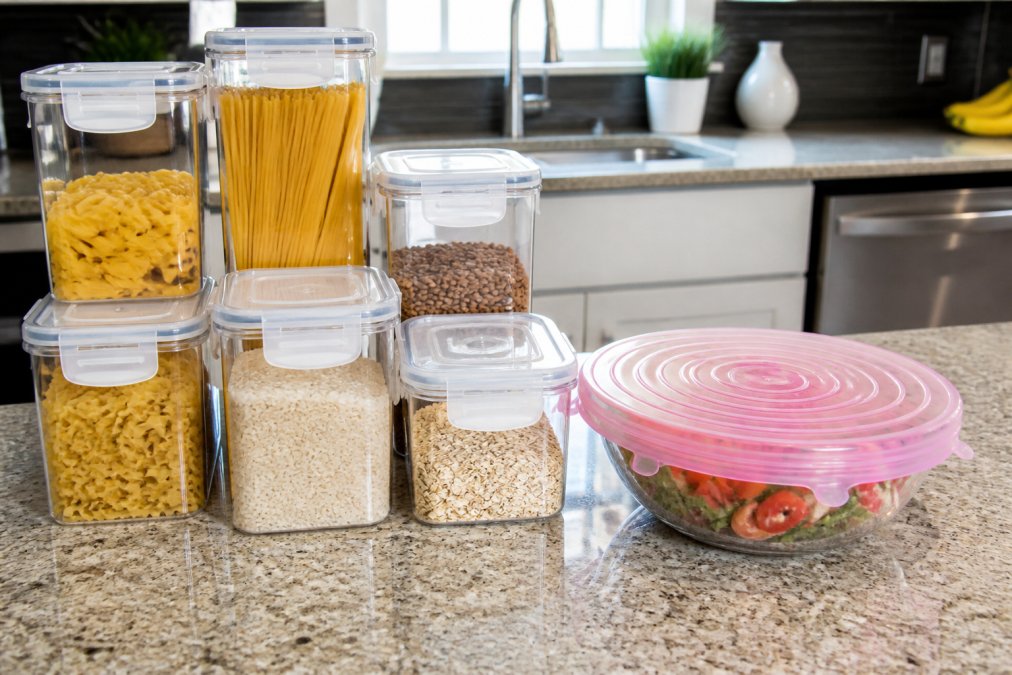
Le silicone de qualité alimentaire supporte les températures élevées, se plie sans se casser et crée un joint étanche. Les couvercles extensibles en silicone (16 tailles universelles) à 22,99 $ remplacent un tiroir rempli de film plastique et de papier d'aluminium. Ils s'étirent sur les bols, les casseroles et les fruits coupés, créant un joint réutilisable et compatible avec le micro-ondes qui élimine les plastiques à usage unique.

Pour l'organisation du garde-manger, recherchez des matériaux épais et résistants aux chutes. L' ensemble de bocaux de stockage hermétiques à 31,29 $ utilise du PET épais avec un anneau d'étanchéité en silicone intégré, protégeant contre l'humidité et la poussière. La conception encastrée du couvercle permet un empilement stable, maximisant l'espace dans vos placards.
Améliorations de nettoyage intelligentes : patins et têtes de balai réutilisables qui permettent d'économiser
Les produits de nettoyage pèsent sur les budgets ménagers car ils sont conçus pour être jetables. Une approche plus rentable consiste à investir dans des composants réutilisables que vous lavez et réutilisez.
Le coût réel des systèmes de nettoyage jetables
Le même calcul s'applique aux chiffons à poussière, aux feuilles pour sèche-linge et aux recharges d'éponges.
Découvrez nos offres du jour →
Un patin en microfibre réutilisable dure des centaines de lavages. Le coût initial est légèrement plus élevé, mais le coût sur l'ensemble du cycle de vie chute considérablement après les premiers mois.
Choisir le bon système de balai pour vos sols
Tous les systèmes de balai ne se valent pas, et le meilleur choix dépend de votre type de sol et de la fréquence de nettoyage.
- Balais vaporisateurs (ex. : Swiffer WetJet) : Pratiques pour les nettoyages rapides, mais la solution de nettoyage propriétaire et les patins jetables créent des coûts récurrents. Si vous en possédez déjà un, passer à des patins réutilisables et à une bouteille rechargeable avec votre propre nettoyant pour sol élimine la majeure partie de la dépense courante.
- Balais rotatifs (ex. : Vileda Turbo) : Ils utilisent un seau avec un mécanisme rotatif pour essorer la tête de balai. Ils utilisent uniquement de l'eau et le nettoyant de votre choix. Le coût principal est la tête de balai elle-même, qui s'use après 6 à 12 mois d'utilisation régulière.
- Balais vapeur : Ils utilisent la chaleur pour assainir les sols sans produits chimiques. Ils sont efficaces sur les sols durs scellés, mais ne conviennent pas aux bois non scellés ou aux stratifiés. Les patins sont lavables, ce qui les rend rentables au fil du temps, mais l'appareil est plus cher à l'achat.
Un schéma courant parmi les ménages économes consiste à posséder un balai vaporisateur pour les nettoyages rapides quotidiens et un balai rotatif pour le nettoyage en profondeur hebdomadaire.
Prolonger la durée de vie de vos têtes de balai
Les têtes de balai s'usent plus vite qu'elles ne le devraient à cause d'un mauvais entretien. Lavez-les avec un détergent doux et séchez-les à l'air libre pour maximiser leur durée de vie.
Les têtes de balai rotatives montrent des signes d'usure lorsque les fibres deviennent emmêlées et perdent leur capacité d'absorption. Remplacer seulement la tête, et non l'ensemble du système balai et seau, est l'approche la plus économique.
Alternatives réutilisables pour chaque tâche ménagère
Au-delà des têtes de balai, plusieurs autres produits de nettoyage jetables ont des alternatives durables et lavables :
- Chiffons à poussière : Les chiffons électrostatiques réutilisables peuvent être lavés et réutilisés des dizaines de fois.
- Alternatives aux éponges : Les brosses en silicone ou les éponges en cellulose lavables au lave-vaisselle durent plus longtemps que les éponges traditionnelles.
- Bouteilles de nettoyage : Au lieu d'acheter des bouteilles de spray jetables, investissez dans quelques vaporisateurs robustes et remplissez-les avec des solutions de nettoyage concentrées mélangées à de l'eau.
Des substitutions de produits spécifiques qui valent le coup
Les patins de balai en microfibre réutilisables pour Swiffer WetJet à 12,16 $ remplacent un flux constant de patins jetables. Utilisez-les humides pour laver ou secs pour dépoussiérer, puis passez-les en machine. Un petit coût initial élimine une dépense récurrente et réduit les déchets.
Au lieu de remplacer tout votre balai à franges rotatif, achetez une Tête de balai en microfibre de rechange pour Vileda Turbo 2-en-1 à 20,72 $. Cela permet de restaurer les performances pour une fraction du coût d'une unité neuve.
Une routine d'entretien simple pour maximiser la durée de vie
Pour tirer le meilleur parti de tout produit de nettoyage réutilisable, suivez cette routine de base :
- Rincez immédiatement après usage pour éviter que la saleté et la solution nettoyante ne sèchent dans les fibres.
- Lavez chaque semaine à l'eau tiède avec un détergent doux, sans adoucissant ni eau de Javel.
- Laissez sécher complètement à l'air libre avant de ranger pour éviter les moisissures et les odeurs.
- Alternez entre deux jeux de patins ou de têtes de balai afin que chacun ait le temps de sécher entièrement entre les utilisations.
Cette routine peut doubler la durée de vie de vos outils de nettoyage, rendant l'option réutilisable encore plus économique.
Bases de la science des matériaux : comment repérer la durabilité du plastique, du bois et du silicone
Vous n'avez pas besoin d'un diplôme en chimie pour faire des achats intelligents, mais comprendre quelques principes fondamentaux des matériaux change votre façon de consommer. Évaluez la qualité de fabrication avant d'acheter, pas après que l'objet soit cassé.
- Plastique : Tous les plastiques ne sont pas égaux. Recherchez le PET ou le PP, qui sont plus denses et plus résistants aux chutes. Évitez les plastiques fins et flexibles qui semblent bon marché et sont sujets aux fissures de contrainte. Vérifiez la finition brillante et lisse, qui indique souvent un moulage plus épais et de meilleure qualité.
- Bois : Le bois massif offre une meilleure longévité que les panneaux de particules ou le MDF. Regardez les assemblages ; les assemblages à queue d'aronde ou à tourillons sont plus solides que les agrafes ou la colle.
- Silicone : Le silicone de qualité alimentaire doit être flexible mais ferme, reprenant sa forme originale lorsqu'il est tordu. Il ne doit pas avoir une forte odeur chimique. Le silicone de haute qualité résiste aux taches.
Ces connaissances vous aident à évaluer le rapport qualité-prix de n'importe quel article.
Le calendrier des soldes saisonniers : quand acheter vos essentiels de maison pour un maximum d'économies
Rythmer vos achats selon les grands cycles de vente au détail peut réduire considérablement le coût des essentiels durables pour la maison. Acheter au prix fort est rarement nécessaire si vous savez quand les détaillants vident leurs stocks pour faire place aux nouveautés.
Voici un guide général des meilleurs moments pour acheter des catégories spécifiques :
| Catégorie | Meilleur moment pour acheter | Pourquoi ça marche |
|---|---|---|
| Appareils de cuisine & ustensiles | Novembre (Black Friday) & janvier | Les nouveaux modèles sortent au début du printemps, les anciens stocks sont donc fortement soldés |
| Literie & linge de maison | Janvier (ventes blanches) | Les détaillants soldent traditionnellement le linge de maison après la période des fêtes |
| Mobilier d'extérieur & outils | Fin août / septembre | Liquidation pour faire de la place aux stocks des fêtes |
| Rangement & organisation | Janvier & septembre | Les résolutions du Nouvel An et la rentrée stimulent la demande |
Au-delà de ces événements majeurs, gardez un œil sur les sites de ventes quotidiennes. Chez Dream Deal Shop, nous sélectionnons de nouveaux produits chaque jour, ce qui signifie que vous pouvez trouver de vraies réductions sur des articles pour la maison, le bien-être et le style de vie. Comme ces offres sont limitées et ne sont pas réapprovisionnées, il faut agir rapidement pour obtenir un article de haute qualité à un prix réellement réduit.
Conclusion : construisez votre intérieur lentement avec des pièces qui durent
Trouver des essentiels durables pour la maison tout en respectant un budget est une stratégie qui demande de la patience, une connaissance des matériaux et un timing intelligent. En privilégiant les outils polyvalents, en comprenant l'intégrité des matériaux et en préférant le réutilisable au jetable, vous construisez un intérieur qui vous servira pendant des années sans coûts de remplacement constants.
Commencez par les articles que vous utilisez quotidiennement et donnez-leur la priorité. Une tête de balai à 20,72 $ qui restaure l'efficacité de votre nettoyage est un meilleur investissement qu'un balai qui casse en deux mois. Arrêtez de payer deux fois pour le même article.
Chez Dream Deal Shop, nous facilitons cela en sélectionnant des trouvailles durables et pratiques que nous proposons à de vraies remises grâce à nos offres quotidiennes. Que vous ayez besoin de contenants de cuisine hermétiques pour réduire le gaspillage alimentaire ou de patins de nettoyage réutilisables pour éliminer les dépenses récurrentes, notre collection se concentre sur des articles offrant une réelle valeur à long terme. Profitez de l'offre d'aujourd'hui et commencez à bâtir un intérieur qui dure.
Questions fréquentes
Quels sont les essentiels de maison les plus négligés qui devraient être durables ?
Les filtres d'évier, les porte-savons et les contenants de stockage sont souvent achetés à bas prix et remplacés fréquemment. Un filtre à cheveux en silicone pour douche coûte environ 17,99 $. De même, un porte-savon auto-drainant évite que le savon ne se transforme en bouillie. Ces petits objets subissent une usure quotidienne ; dépenser un peu plus pour du silicone ou du plastique épais devient rentable en quelques mois.
Comment distinguer les produits ménagers bon marché de ceux qui sont abordables ?
Les produits bon marché tombent en panne en quelques semaines et doivent être remplacés. Les produits abordables coûtent plus cher à l'achat mais durent des années. Vérifiez l'épaisseur des matériaux : les bocaux en plastique PET résistent mieux aux chutes que l'acrylique fin. Recherchez des joints en silicone plutôt que de simples couvercles à pression. Pour les textiles, une microfibre au tissage serré emprisonne plus de saleté et survit mieux au lavage. Demandez si l'article est réparable ou si des pièces détachées existent, comme une recharge de tête de balai.
Où trouver les essentiels ménagers les moins chers sans sacrifier la qualité ?
Les sites de ventes quotidiennes qui sélectionnent leurs produits, plutôt que les places de marché avec d'innombrables vendeurs tiers, proposent des produits de qualité. Recherchez des boutiques qui fournissent des spécifications techniques et des détails précis sur les produits. Des bocaux hermétiques à 31,29 $ l'ensemble, ou des patins de balai réutilisables à 12,16 $, battent les prix des grandes surfaces quand on prend en compte le nombre de remplacements jetables évités.
Quelles sont les 10 choses qui peuvent donner une apparence bas de gamme à mon intérieur ?
Le désordre visible et les accessoires usés sont en tête de liste. Les câbles emmêlés, les savons ramollis, les pulls boulochés en évidence et les contenants dépareillés signalent un manque d'entretien. Une boîte range-câbles à 43,99 $ cache les multiprises. Un rasoir anti-bouloches électrique à 44,99 $. Remplacer les patins jetables par des réutilisables garde les sols plus propres. Ces petites améliorations coûtent moins de 50 $ chacune, mais changent radicalement l'aspect soigné de votre intérieur.