


Meilleurs ustensiles de cuisine abordables : 15 incontournables durables
Table des matières
- Pourquoi les ustensiles de cuisine bon marché ne durent pas (et quoi acheter à la place)
- Comparaison rapide : Les meilleurs ustensiles de cuisine abordables en un coup d'œil
-
Les 15 meilleurs ustensiles de cuisine abordables que nous recommandons
- 1. Couteau de chef : Le seul outil dans lequel investir
- 2. Planches à découper : Bois contre plastique contre bambou
- 3. Batterie de cuisine : Quand choisir l'antiadhésif ou l'acier inoxydable
- 4. Plaques de cuisson et bols mélangeurs : Les indispensables
- 5. Ustensiles : Spatule, pince, fouet et plus
- 6. Économe et autres petits outils de préparation
- 7. Passoire et récipients de conservation
- Gadgets de cuisine essentiels pour débutants : Un kit de démarrage
- Meilleurs ustensiles pour le « meal prep » : Gagnez du temps et de l'argent
- Comment organiser une petite cuisine avec un petit budget
- Où trouver des bonnes affaires et quoi acheter d'occasion
- Verdict final : Commencez petit, achetez intelligemment
- Foire aux questions
Dernière mise à jour : 6 septembre 2026
Équiper une cuisine à partir de zéro est un rite de passage, mais c'est aussi là que la plupart des budgets s'essoufflent. La sagesse conventionnelle veut que vous ayez besoin de dizaines de gadgets spécialisés, mais la réalité est qu'une poignée d'articles bien choisis suffira pour presque tout ce que vous cuisinerez. Le modèle le plus évident est le suivant : l'option la moins chère en magasin n'est presque jamais la plus rentable sur le long terme. Ce guide des meilleurs ustensiles de cuisine abordables se concentre sur des articles qui survivent à des années d'utilisation intensive, et pas seulement au premier mois.
L'information la plus importante pour quiconque constitue un kit de démarrage est que le prix et la valeur ne coïncident pas toujours. Un ustensile de cuisine économique est un outil qui remplit bien sa fonction, résiste à l'usure et peut être réparé ou aiguisé plutôt que remplacé. Ci-dessous, nous vous montrerons exactement comment distinguer les vraies bonnes affaires des produits jetables, en couvrant les 15 indispensables qui ont leur place dans toute cuisine, le matériel à éviter, et où trouver des articles durables à petit prix.
Pourquoi les ustensiles de cuisine bon marché ne durent pas (et quoi acheter à la place)
La plupart des défaillances des ustensiles de cuisine ont une cause racine : la finesse des matériaux. Un couteau d'office à la lame fragile se plie au lieu de couper, une spatule au manche faible casse sous la pression, et une poêle antiadhésive à base fine crée des points de surchauffe qui brûlent les aliments. Les fabricants réduisent les coûts en diminuant l'épaisseur des matériaux, et le résultat est un produit qui tombe en panne en quelques mois plutôt qu'en quelques années.
La solution est de changer votre état d'esprit : passez du « prix à l'achat » au « coût par utilisation ». Un outil qui coûte deux fois plus cher mais dure cinq fois plus longtemps est une meilleure affaire. Recherchez de l'acier inoxydable de forte épaisseur, des manches solidement rivetés et des articles qui semblent substantiels en main. Le poids est souvent un indicateur fiable de durabilité, car il indique qu'une plus grande quantité de matière a été utilisée pour la fabrication.
Comparaison rapide : Les meilleurs ustensiles de cuisine abordables en un coup d'œil
| Outil | Matériau à privilégier | Caractéristique clé | Idéal pour |
|---|---|---|---|
| Couteau de chef | Acier inoxydable à haute teneur en carbone | Pleine soie, prise en main confortable | 90 % des tâches de coupe quotidiennes |
| Planche à découper | Bois ou bambou | Épaisse, construction bois de bout | Protéger le tranchant des couteaux |
| Poêle antiadhésive | Aluminium avec revêtement céramique | Base résistante à la déformation | Œufs, poissons délicats |
| Poêle en inox | Construction multicouche (tri-ply) | Répartition homogène de la chaleur | Saisir, déglacer, sauces |
| Plaque de cuisson | Acier de forte épaisseur | Bords relevés | Rôtir légumes et protéines |
| Bols mélangeurs | Acier inoxydable | Ensemble emboîtable avec couvercles | Préparation, stockage, service |
| Économe | Lame en acier au carbone | Manche ergonomique | Préparation rapide des légumes racines |
Les 15 meilleurs ustensiles de cuisine abordables que nous recommandons
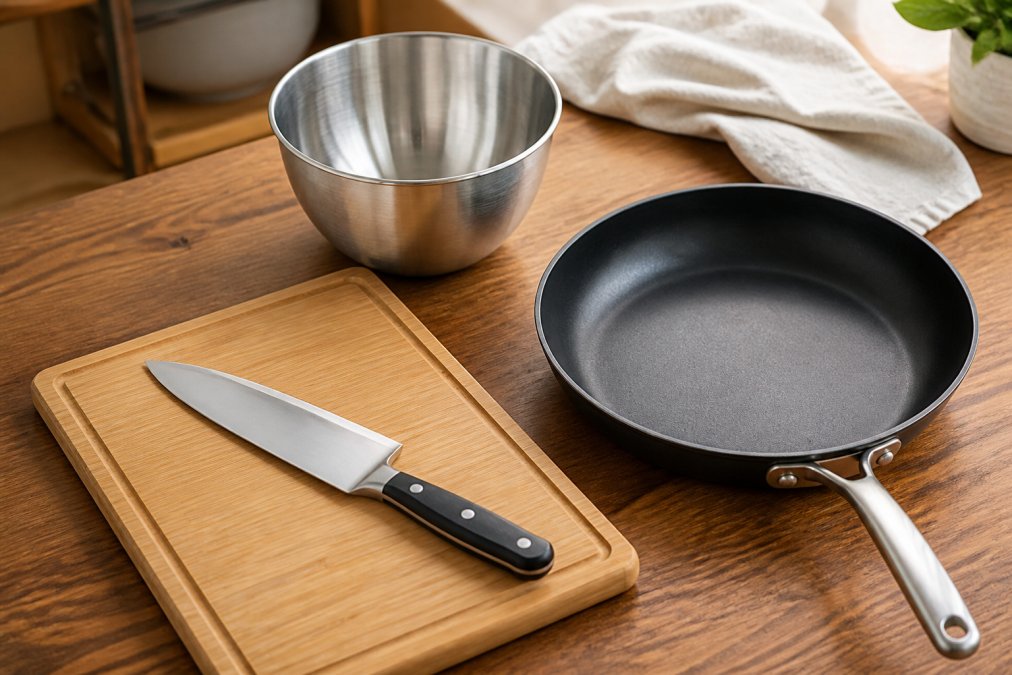
Un kit de démarrage complet pour un cuisinier amateur est plus restreint que ce que la plupart des gens supposent. Les 15 outils ci-dessous couvrent la préparation, la cuisson, la pâtisserie et le stockage sans superflu. Chaque choix a été retenu parce qu'il justifie sa place par une utilisation quotidienne, et chacun dispose d'une version abordable qui ne fait aucun compromis sur les fonctionnalités essentielles.
1. Couteau de chef : Le seul outil dans lequel investir
Si vous devez allouer plus d'argent à un seul article, faites-en votre couteau de chef. Un couteau de chef de 20 cm gère le tranchage, le découpage en dés, l'éminçage et le hachage, remplaçant la plupart des autres lames de votre tiroir. Recherchez une lame en acier inoxydable à haute teneur en carbone avec une « pleine soie », ce qui signifie que le métal traverse toute la longueur du manche.
Un couteau de qualité doit être équilibré et confortable dans votre main. La meilleure option abordable provient d'une marque réputée offrant un affûtage à vie ou un service de garantie, car un bon couteau peut durer des décennies avec un entretien approprié. Évitez les lames estampées avec des manches creux, car ils ont tendance à se briser au niveau de la mitre.
2. Planches à découper : Bois contre plastique contre bambou
Le matériau de la planche à découper affecte à la fois le tranchant de votre couteau et la sécurité alimentaire. Le bois et le bambou sont plus doux pour les lames et résistent naturellement aux bactéries, mais ils nécessitent un lavage à la main et un huilage occasionnel. Les planches en plastique vont au lave-vaisselle et ne coûtent pas cher, ce qui les rend pratiques pour la viande crue, mais elles émoussent les couteaux plus rapidement et développent des rainures profondes qui peuvent abriter des bactéries.
L'approche intelligente consiste à posséder deux planches : une grande planche en bois ou en bambou pour les légumes et le pain, et une fine planche en plastique réservée à la volaille et à la viande crues. Remplacez les planches en plastique lorsqu'elles sont trop marquées. Pour les petites cuisines, une planche en bambou avec une rigole offre le meilleur équilibre entre durabilité, prix et protection des lames.
3. Batterie de cuisine : Quand choisir l'antiadhésif ou l'acier inoxydable
Le débat entre antiadhésif et acier inoxydable a une réponse simple : vous avez besoin des deux, mais pour des tâches différentes. Une poêle antiadhésive excelle pour les œufs, le poisson délicat et tout ce qui a tendance à attacher, et nécessite moins de matières grasses pour la cuisson. Les poêles en acier inoxydable sont les bêtes de somme pour saisir la viande, déglacer les sucs de cuisson et cuisiner des ingrédients acides comme les tomates, qui peuvent endommager les revêtements antiadhésifs avec le temps.
Pour des ustensiles économiques, privilégiez une poêle antiadhésive de qualité (25 à 30 cm) et une poêle ou sauteuse en acier inoxydable. Vérifiez que le revêtement antiadhésif est sans PFOA et que la poêle possède une base épaisse et résistante à la déformation. Une poêle déformée tournoie sur la plaque et chauffe de manière inégale, ruinant à la fois la cuisson et l'efficacité de vos brûleurs.
4. Plaques de cuisson et bols mélangeurs : Les indispensables
Les plaques de cuisson et les bols mélangeurs sont les héros méconnus de la préparation des repas. Une plaque à rebords de forte épaisseur est idéale pour rôtir des légumes, cuire des biscuits et récupérer les jus des plats placés au-dessus dans le four. Achetez-en au moins deux, car la plupart des recettes gagnent à être cuites sur plusieurs plaques à la fois.
Les bols mélangeurs en acier inoxydable sont presque indestructibles, légers et non réactifs, ce qui signifie qu'ils ne donneront pas de goût métallique aux aliments acides. Un ensemble emboîtable de trois ou quatre tailles avec des couvercles hermétiques couvre la préparation, la marinade et le stockage. Choisissez des bols avec une base large et stable et un rebord roulé offrant une prise en main sûre lors du fouettage.
5. Ustensiles : Spatule, pince, fouet et plus
Vous avez besoin de moins d'ustensiles de cuisine que ce que prétendent la plupart des guides, mais ceux que vous achetez doivent être résistants à la chaleur et durables. Une spatule en silicone supporte des températures élevées sans fondre et ne rayera pas vos poêles antiadhésives. Une pince à ressort aux bords dentelés saisit fermement les aliments et sert également d'outil de service. Un fouet ballon incorpore l'air dans les œufs et les sauces plus efficacement qu'une fourchette ne le fera jamais.
6. Économe et autres petits outils de préparation
L'humble économe est l'un des outils les plus utilisés dans une cuisine professionnelle, pourtant la plupart des cuisiniers amateurs achètent le moins cher disponible. Un économe bien aiguisé en acier au carbone avec un manche ergonomique facilite la préparation des carottes, pommes de terre et courgettes, tandis qu'une lame émoussée transforme la tâche en corvée. Un économe en Y, où la lame est perpendiculaire au manche, offre un meilleur contrôle et fatigue moins le poignet.
Parmi les autres petits outils de préparation à inclure, citons une râpe fine type Microplane pour le zeste d'agrumes et le fromage à pâte dure, une passoire robuste pour rincer les produits et égoutter les pâtes, ainsi qu'un jeu de cuillères et tasses à mesurer. Chacun justifie sa place par la fréquence d'utilisation, et aucun n'exige un gros investissement pour obtenir une version durable.
7. Passoire et récipients de conservation
Une passoire est essentielle pour laver les produits frais et égoutter les pâtes, le riz et les légumineuses. Cherchez un modèle avec une base stable, des poignées confortables et des pieds permettant de le poser au-dessus de l'évier. L'acier inoxydable dure plus longtemps que le plastique et ne se colore pas avec la sauce tomate ou le curcuma.
Profitez des offres du jour ici →
Pour le stockage, un ensemble de récipients en verre ou en plastique sans BPA avec couvercles hermétiques remplace avantageusement les sacs jetables et le papier aluminium pour les restes. Les récipients en verre passent du réfrigérateur au four puis à la table, tandis que les versions en plastique sont plus légères pour transporter des déjeuners. Choisissez un ensemble emboîtable avec des couvercles assortis, car les récipients dépareillés sont la cause principale du chaos dans les placards.
Gadgets de cuisine essentiels pour débutants : Un kit de démarrage
Pour quelqu'un qui équipe son premier appartement ou sa cuisine étudiante, la liste des gadgets de cuisine essentiels est plus courte que ce que suggèrent la plupart des guides. Commencez par le couteau de chef, une planche à découper en bois, une poêle antiadhésive, une casserole en inox, une plaque de cuisson, des bols mélangeurs et les ustensiles de base. Ce kit couvre le petit-déjeuner, le déjeuner et le dîner.
N'ajoutez des outils que lorsqu'une recette l'exige vraiment. Un presse-ail est une commodité, pas une nécessité, car un couteau de chef émince l'ail en quelques secondes. Un robot pâtissier est un luxe jusqu'à ce que vous fassiez du pain chaque semaine. La stratégie la plus rentable consiste à cuisiner avec votre kit de base pendant un mois, noter quelles tâches semblent difficiles, puis acheter l'outil spécifique qui résout ce problème.
Meilleurs ustensiles pour le « meal prep » : Gagnez du temps et de l'argent
Le « meal prep » (préparation des repas à l'avance) est le domaine où les bons outils se rentabilisent en temps gagné et en réduction des dépenses liées à la livraison de repas. Les meilleurs outils se concentrent sur la cuisine en gros volume et le stockage efficace. Une grande marmite permet de cuire céréales, légumineuses et soupes en quantité, tandis que la plaque de cuisson rôtit une semaine de légumes en une seule fois.
Les récipients en verre à compartiments permettent de garder les ingrédients préparés organisés et visibles dans le réfrigérateur. Une balance de cuisine numérique garantit des portions cohérentes et simplifie l'adaptation des recettes. La combinaison de la cuisson en gros et d'un bon stockage signifie que vous cuisinez une fois pour plusieurs repas, ce qui est le moyen le plus fiable de réduire le gaspillage alimentaire et les coûts de restauration.
Comment organiser une petite cuisine avec un petit budget
Organiser une petite cuisine avec un budget limité commence par faire le tri dans ce que vous possédez. La plupart des cuisiniers utilisent une fraction de leurs outils régulièrement ; la première étape consiste donc à donner ou ranger tout ce qui n'a pas été utilisé depuis six mois. Cela libère de l'espace de rangement sans dépenser un centime.
Pour les ustensiles restants, le rangement vertical permet de maximiser l'espace limité des plans de travail et des tiroirs. Une barre magnétique murale permet de suspendre couteaux et ustensiles en métal, une crémaillère suspend les poêles au plafond, et des étagères empilables doublent la surface utile à l'intérieur des placards. Des contenants transparents et étiquetés pour les produits secs rendent les ingrédients visibles et accessibles. Ces solutions peu coûteuses créent de l'ordre sans nécessiter de rénovation.
Où trouver des bonnes affaires et quoi acheter d'occasion
Dénicher de véritables bonnes affaires en matière d'ustensiles de cuisine demande de savoir ce qu'il est sûr d'acheter d'occasion et ce qu'il vaut mieux acheter neuf. Les poêles en fonte, les casseroles en acier inoxydable et les plats en verre vont au four sont d'excellentes trouvailles d'occasion, car ils sont presque indestructibles et peuvent être remis à neuf avec un bon nettoyage. Une poêle en fonte rouillée redevient parfaitement fonctionnelle après un nettoyage à la laine d'acier et un nouveau culottage.
Achetez neuf tout ce qui possède un revêtement antiadhésif, une lame tranchante, ou tout ce qui est en contact direct avec les aliments d'une manière qui ne permet pas une stérilisation complète. Les poêles antiadhésives se dégradent avec le temps et le revêtement peut s'écailler dans la nourriture. Lors de vos recherches de bonnes affaires, concentrez-vous sur la qualité du matériau plutôt que sur la marque, et vérifiez que l'article semble solide en main avant de l'acheter.
Verdict final : commencez petit, achetez intelligemment
Les meilleurs ustensiles de cuisine abordables ne sont ni les moins chers, ni les plus onéreux. Ce sont les articles bénéficiant d'une construction solide, de matériaux honnêtes et d'une conception qui facilite la cuisine au quotidien. Commencez avec les 15 ustensiles ci-dessus, achetez la meilleure version que votre budget permet, et n'ajoutez que ce que vos habitudes culinaires exigent.
Construire une cuisine durable est un processus de choix réfléchis, pas une virée shopping unique. Dream Deal Shop facilite ce processus avec des arrivages quotidiens sélectionnés avec soin d'essentiels pour la maison et le style de vie à des remises réelles, afin que vous puissiez acquérir des ustensiles de qualité dès qu'ils sont disponibles. Comme chaque offre s'épuise et disparaît pour de bon, consulter la collection du jour est le meilleur moyen de mettre la main sur des pièces durables et économiques avant qu'elles ne soient parties. Lancez-vous avec Dream Deal Shop et construisez une cuisine que vous n'aurez pas besoin de remplacer.
Questions fréquemment posées
Quel est le meilleur set d'ustensiles de cuisine économique ?
Plutôt qu'un grand set assorti, achetez les ustensiles individuels que vous utiliserez réellement. Commencez par une spatule en silicone résistante à la chaleur, une pince en métal, un fouet et une cuillère percée. Recherchez des ustensiles à construction monobloc solide ou avec des poignées rivetées, car ils survivent au lave-vaisselle et à un usage intensif. Quelques pièces de qualité choisies parmi les meilleurs ustensiles de cuisine abordables surpasseront un set de 20 pièces dont la moitié reste inutilisée.
Comment construire une cuisine fonctionnelle avec un budget limité ?
Donnez la priorité à votre style de cuisine. Si vous faites des œufs tous les jours, une bonne poêle antiadhésive est importante. Si vous faites rôtir des légumes, une plaque de cuisson robuste est essentielle. Investissez le plus dans votre couteau de chef, car il est utilisé pour presque chaque repas. Envisagez une poêle en acier carbone pour saisir à haute température. Pour tout le reste, commencez avec des versions basiques et ne montez en gamme que lorsque vous atteignez une limite.
Quels sont les meilleurs appareils de cuisine bon marché ?
Pour la plupart des cuisiniers amateurs, un thermomètre à lecture instantanée est l'appareil bon marché le plus précieux. Il évite les viandes trop cuites et garantit la sécurité alimentaire pour environ le prix d'un repas à emporter. Une simple balance de cuisine numérique améliore également la précision en pâtisserie. Évitez les gadgets à fonction unique comme les cuiseurs à œufs électriques. Concentrez-vous plutôt sur des outils multifonctions comme un mixeur plongeant, qui peut réduire les soupes en purée, monter de la crème et préparer des smoothies dans le récipient que vous possédez déjà.
Est-il sûr d'acheter des ustensiles de cuisine d'occasion ?
Oui, pour de nombreux articles. Les poêles en fonte et en acier carbone sont presque indestructibles et peuvent être restaurées avec un peu d'huile de coude. Les bols mélangeurs et ustensiles en acier inoxydable sont également des valeurs sûres. Évitez d'acheter des poêles antiadhésives d'occasion, car le revêtement pourrait être rayé ou usé, ce qui peut libérer des particules dans la nourriture. Vérifiez également toute planche à découper d'occasion pour détecter les rainures profondes où les bactéries peuvent se cacher, et désinfectez-la avec de l'eau chaude savonneuse avant la première utilisation.
Quelle est la meilleure marque pour les ustensiles de cuisine ?
Vous n'avez pas besoin d'une seule marque pour tout. Les chefs professionnels mélangent et assortissent souvent : un couteau japonais, une poêle française en acier carbone et des plaques de cuisson fabriquées aux États-Unis. Concentrez-vous sur le matériau et la construction plutôt que sur le logo. Pour des options économiques, recherchez des outils en acier inoxydable massif ou en bois sans pièces en plastique pouvant casser. Un test simple : s'il semble lourd et solide en main, il durera probablement plus longtemps qu'une alternative plus légère et fragile.