

How to Spot Inflated Prices: 2026 Shopper's Guide
Table of Contents
- Why Inflated Prices Are Harder to Catch in 2026
- What Counts as an Inflated Price (And What Doesn't)
- How to Spot Fake Discounts Before You Click Buy
- How to Identify Shrinkflation on the Shelf
- Price Tracking Tools That Show Real History
- Build Your Own Personalized Inflation Tracker
- When a Real Discount Is Worth Grabbing
- Frequently Asked Questions
Last Updated: September 29, 2026
Why Inflated Prices Are Harder to Catch in 2026
Learning how to spot inflated prices has become a real survival skill for household budgets. Prices creep up quietly, packages shrink, and "was" prices get invented to make a discount look bigger than it is. This guide from Dream Deal Shop breaks down the exact signals to watch for, from the shelf to the checkout page.
- Small, frequent increases are harder to notice than one big jump
- "Sale" tags can hide a price that never actually dropped
- Package sizes change more often than prices do
What Counts as an Inflated Price (And What Doesn't)
An inflated price is any price pushed above what the market and the product's real value justify. A normal price rise from higher costs is not inflation trickery. An inflated price is when the increase has no honest reason behind it.
Here is the split most shoppers miss:
- Legitimate rise: raw materials, shipping, or wages cost more, so the shelf price follows
- Inflated price: the same product, same cost, higher price with no clear reason
- Fake discount: a price hiked first, then "cut" back to look like a deal
Inflation vs. Price Gouging: The Legal Line
The legal line between inflation and price gouging comes down to timing and intent. Inflation is a broad, economy-wide rise in prices. Price gouging is a seller charging unfair prices during an emergency or shortage, and many places treat it as illegal.
How to Spot Fake Discounts Before You Click Buy
Fake discounts are the easiest inflated prices to fall for, because they wear a sale tag. The trick is a "was" price that was never real. The store raises the price for a week, then "drops" it back and calls it a deal.
Spot them with these checks:
- Compare the sale price to your memory, not the tag
- Check if the "was" price ever actually existed
- Look at the discount percentage, which is often rounded up
- See if the item is "on sale" every single week
Red Flags for Price Gouging
Price gouging shows up as a sudden, steep jump on something people need right now. Watch for these signals:
- Essentials like water, batteries, or medicine spiking during a shortage
- A price that jumps overnight with no cost explanation
- "Limited stock" pressure paired with a big markup
- Sellers who only appear during emergencies
How to Identify Shrinkflation on the Shelf
Shrinkflation is when a product gets smaller but the price stays the same. You pay the same money for less product, so the real price went up without the tag changing. Learning how to identify shrinkflation means reading the weight, not the price.
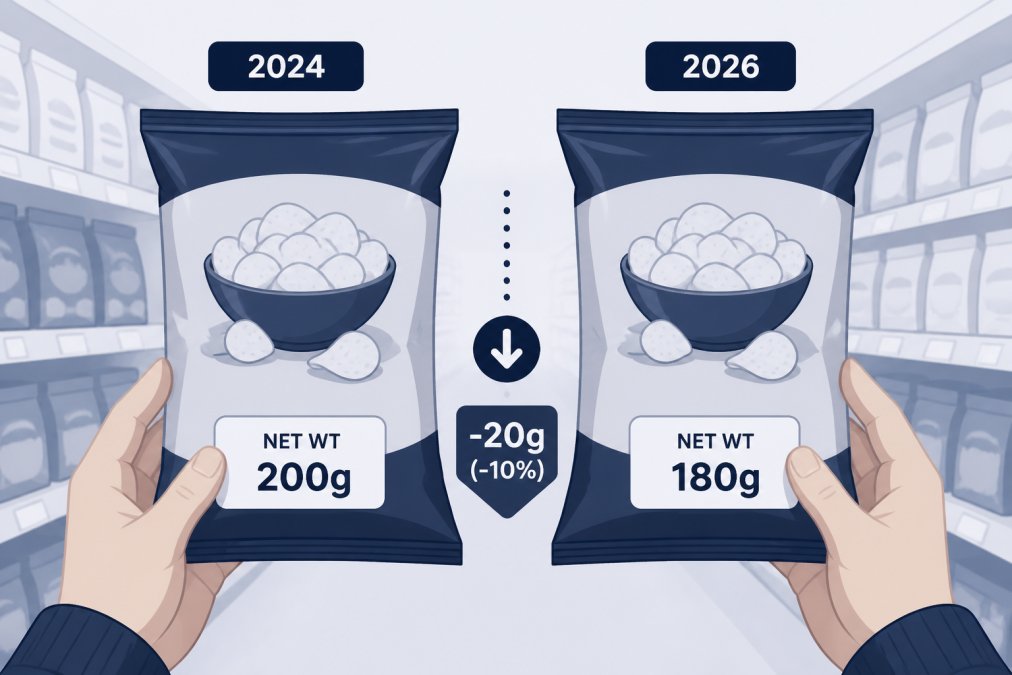
Here is how to catch it:
- Check the grams or litres on the label, not just the price
- Compare the same product across brands by weight
- Notice when a familiar pack feels lighter or looks slimmer
- Watch for "new look" labels, which often hide a smaller size
The Unit Price Method: Your Secret Weapon
Unit pricing breaks the cost down to a standard measure, like price per 100g, per litre, or per wash, so you can compare apples to apples. This is the fastest way to spot shrinkflation and inflated prices when package sizes differ.
- Find the unit price on the shelf tag. Most stores print it in small text below the retail price. It might say "$0.25 per 100g" or "$0.03 per fluid ounce." If it's not there, use a calculator.
- Calculate it yourself if needed. Divide the total price by the number of units (grams, litres, etc.). For example, a 500g box of cereal at $4.00 is $0.80 per 100g.
- Compare across brands and sizes. A larger box may have a higher unit price than a smaller one, sometimes the bulk buy is a trap. Always check the unit price, not the sticker price.
- Watch for changes over time. If your favorite brand's unit price jumps while the package looks the same, it might be shrinkflation. Snap a photo of the unit price each shopping trip to track it.
Real-World Examples of Shrinkflation
Shrinkflation is common in household staples. Here are a few patterns to watch for:
- Cereal: Boxes that were once 500g now weigh 450g, but the price stays the same. The unit price per 100g rises.
- Laundry detergent: Concentrated formulas mean you use less per load, but the bottle may shrink from 50 loads to 40 loads while the price holds steady. Check the cost per wash.
- Snacks: A bag of chips might go from 200g to 180g, with the same retail price. The unit price per 100g increases by about 11%.
- Toilet paper: Rolls may have fewer sheets or be narrower. Compare cost per sheet or per square meter.
Price Tracking Tools That Show Real History
Price tracking tools show you what a product actually cost over time, so you can tell a real deal from a fake one. They log price changes and flag the moments when a "discount" is just a return to normal.
3-Pack Square Rimless Sunglasses →
Most tools work the same way:
- You paste a product link and set a target price
- The tool watches the price and alerts you when it drops
- You see a history graph, so you know the true low point
Unit Price Comparison Tools
Unit price comparison tools break the price down to cost per gram, per litre, or per item. This is the fastest way to spot inflated prices when package sizes differ.
| What to Compare | Unit Price Measure | Why It Matters |
|---|---|---|
| Cereal boxes | Cost per 100g | Bigger box is not always cheaper |
| Laundry detergent | Cost per wash | Concentrated formulas change value |
| Bottled drinks | Cost per litre | Multipacks can cost more per litre |
| Snacks | Cost per 100g | Shrinkflation hides here most |
Build Your Own Personalized Inflation Tracker
A personalized inflation tracker is a simple list of the items you buy most, with their prices logged over time. It turns vague "everything feels pricier" into hard numbers you can act on. While most inflation guides focus on macro data like the Consumer Price Index (CPI), tracking your own personal inflation rate gives you a precise picture of how price changes affect your household.
- List your 10 to 15 most-bought items. Include groceries, household supplies, and personal care products. Be specific: "2% milk, 1 gallon" not just "milk."
- Record the price and the package size each time you shop. Note the date, store, and any promotions. If the size changes, log that too, this is how you catch shrinkflation.
- Calculate the unit price for each item. Divide the price by the size (e.g., cost per ounce, per sheet, per load). This standardizes your data so you can compare accurately over time.
- Review monthly. Look for items where the unit price has increased. Flag any item that rose while the size stayed the same, or where the size dropped but the price didn't.
Tools to Automate Your Tracker
If you prefer not to build a spreadsheet from scratch, several apps can help:
- Flipp: Lets you browse weekly ads and clip digital coupons. You can create a shopping list and track prices over time.
- Basket: Crowdsources grocery prices from users, so you can compare prices across stores and see historical trends.
- Google Sheets or Excel: Use a simple template with columns for date, item, price, size, and unit price. Add a chart to visualize trends.
- Receipt scanning apps: Apps like Fetch Rewards or Ibotta let you scan receipts for cash back, but they also store your purchase history, which you can review for price changes.
From Data to Action: Using Your Tracker
Once you have a few months of data, you can take action:
- Identify substitutes: If the unit price of your favorite brand rises, try a store brand or a different size.
- Stock up strategically: When you see a genuine discount on a non-perishable item you use often, buy extra.
- Adjust your shopping list: Swap out items that have inflated the most for cheaper alternatives.
- Set a personal inflation rate: Calculate the average percentage increase across your basket. This is your personal inflation rate, a more relevant number than the CPI for your budget.
When a Real Discount Is Worth Grabbing
A real discount is worth grabbing when the price is genuinely below the product's normal selling price and you actually need the item. A true deal beats a fake one on three counts: verified history, real need, and honest value.
Here is when to hit buy:
- The price is at or near its lowest recorded point
- You need the item now or soon, not "someday"
- The unit price beats the alternatives
Frequently Asked Questions
How can I tell if a 'sale' price is actually inflated?
Check the item's price history before the sale started. If the 'original' price only appeared a week before the discount, it may be inflated. Price tracking tools show 30 to 90 days of real pricing. Also compare the sale price against other retailers and the unit price, not just the sticker price. A genuine discount beats the lowest price the item has actually sold for in recent months.
What is shrinkflation and how do I spot it?
Shrinkflation is when a brand reduces the amount of product in a package while keeping the price the same or raising it. To spot it, check the net weight printed on the label and compare it to what you remember or what a competitor offers. Unit pricing, the cost per gram or per litre, reveals the real change. If the pack looks the same but weighs less, your cost per unit went up.
Are there tools to track historical price changes?
Yes. Browser extensions and price tracking tools record an item's price over time and alert you when it drops. Some retailers show price history on the product page. For groceries, unit price comparison tools and receipt-scanning apps help you build a personal price log. These tools make hidden inflation visible by showing whether today's price is genuinely lower than the past 30 to 90 days.
Why do retailers inflate prices before a major holiday sale?
Raising the 'original' price before a sale makes the discount look bigger than it is. A product listed at 80 euros, then marked up to 120 euros and offered at '40% off' for 72 euros, is actually more expensive than its regular price. This tactic works because shoppers anchor on the crossed-out number. Checking price history before a holiday sale is the simplest way to avoid it.
Inflation is not going away, and neither are the tricks that hide it. The shoppers who win are the ones who check unit prices, track their own buys, and refuse to trust a "was" price at face value. Dream Deal Shop makes that easier with daily hand-picked drops, real discounts, and a curated mix of home, wellness, and lifestyle finds. Shop today's drop now and grab genuine value before it sells out.