

How to Curate Home Style: A Step-by-Step Guide
Table of Contents
- What Curating Your Home Style Actually Means
- How to Find Your Interior Design Style
- How to Mix Furniture Styles Without the Hodgepodge Look
- Cohesive Home Decor Tips: Color, Texture, and Proportion
- How to Curate Home Style on a Budget with Vintage and Antique Finds
- How to Curate Home Style in a Small Space
- Conclusion: Start Curating Today
- Frequently Asked Questions
Last Updated: October 1, 2026
What Curating Your Home Style Actually Means
Curating home style is the practice of choosing and arranging your belongings with intention, so every piece earns its place instead of simply filling space. This guide from Dream Deal Shop breaks down how to curate home style room by room, even on a tight budget. Most people think they need to buy a whole new living room. They don't.
Styling vs Curating: What's the Difference?
Styling is arranging what you already have to look good right now. Curating is deciding what deserves to stay in your home at all.
Think of it this way:
- Styling moves the cushions around on a sofa you don't love.
- Curating asks whether that sofa belongs in the room in the first place.
- Styling is a weekend job.
- Curating is an ongoing habit.
How to Find Your Interior Design Style
Finding your interior design style starts with noticing what you already gravitate toward, not picking a label off a list. Your style is already there in your saved photos, your favourite clothes, and the corners of your home you actually enjoy sitting in. The goal is to name it, then use that name as a filter for every future purchase.
Build a Vision Board and Spot Your Patterns
Save 20 to 30 images of rooms you love. Don't filter them. Then look for repeats:
- The same two or three colours showing up again and again
- A recurring material, like wood, linen, or brass
- Similar light levels, warm or bright
- The same shapes, curved or straight lines
Name Your Style in One Sentence
A style you can't describe is a style you can't shop for. Write one sentence that captures your patterns, then test every future purchase against it. For example: "Warm minimalism with natural wood, cream textiles, and one brass accent per room." That sentence becomes your filter. If a piece doesn't fit the sentence, it doesn't come home, no matter how good the deal is.
The Psychology Behind Why This Works
Curation is not just aesthetic. It is emotional. Psychology Today's coverage of how physical spaces affect mood explains that cluttered, unfinished rooms tend to raise stress levels, while arranged spaces help people relax. When you name your style, you stop making decisions from a place of anxiety ("Will this look good?") and start making them from a place of clarity ("Does this fit my sentence?").
How to Mix Furniture Styles Without the Hodgepodge Look
Mixing furniture styles works when you pick one style as the anchor and let everything else support it. The hodgepodge look comes from having no anchor at all, where every piece fights for attention.
Use these guardrails:
- Pick one dominant style. It sets the rules for the room.
- Limit yourself to two secondary styles. Three or more and the room loses its thread.
- Repeat one element across pieces. A shared wood tone or metal finish ties different eras together.
- Keep proportions in check. A heavy antique next to a delicate modern chair needs a third piece to bridge them.
Cohesive Home Decor Tips: Color, Texture, and Proportion
Cohesive home decor comes down to three things: a limited colour palette, layered textures, and correct proportions. Get those right and almost any combination of pieces will look intentional.
Scented Aromatherapy Pillar Candles | 5 →
- Colour palette: Choose one base colour, one secondary, and one accent. That's it.
- Textures: Layer at least three, such as wood, fabric, and stone or metal.
- Proportions: Art should span roughly two-thirds of the furniture below it.
- Focal point: Every room needs one. Decide what the eye should land on first.
The 80/20 Rule and Accent Notes
The 80/20 rule in interior design means 80% of a room stays calm and neutral, while 20% carries the personality. That 20% is your accent notes: a bold cushion, a coloured candle, one piece of art that pops.
How to Curate Home Style on a Budget with Vintage and Antique Finds
Budget curation leans on vintage and antique pieces, because they add character that new mass-produced items rarely match, usually for less money. A single well-chosen antique can do more for a room than a cart full of new accessories. But the real advantage of budget curation is not just cost, it is the psychology of buying slowly and intentionally, which most high-end guides ignore entirely.
The Budget Curation Framework
Most budget decorators fail because they buy many small things instead of one good thing. Use this three-step filter before any purchase:
- Set a per-room cap. Decide the maximum you will spend on a single room this season. A common approach is to allocate 70% to one statement piece and 30% to small accents. This forces you to choose quality over quantity.
- Buy one statement piece, not five small ones. One antique mirror beats a shelf of trinkets. The statement piece anchors the room; the small pieces support it.
- Check function before charm. A wobbly chair is a project, not a bargain. If it needs repair, the repair cost counts against your cap.
Where to Look and What to Avoid
- Estate sales and local auctions often have the best prices on solid wood furniture, but you need to inspect in person.
- Thrift stores are best for ceramics, art, and small decor, items where condition is easy to judge.
- Online marketplaces work for statement pieces, but always ask for additional photos of joints, fabric, and undersides.
- Avoid sight-unseen upholstery. Fabric damage and odours are the two most common regrets, and reupholstery often costs more than the piece did.
The Psychology of Slow Curation
Budget curation is not just about saving money. It is about changing your relationship with your home. When you buy slowly and deliberately, each piece carries a memory and a reason. That is the opposite of the anxiety that comes from a room full of impulse purchases. A common pattern is that people who curate on a budget report feeling more attached to their homes than people who furnished them in one weekend, because every object was a decision, not a default.
Small Accents, Big Impact
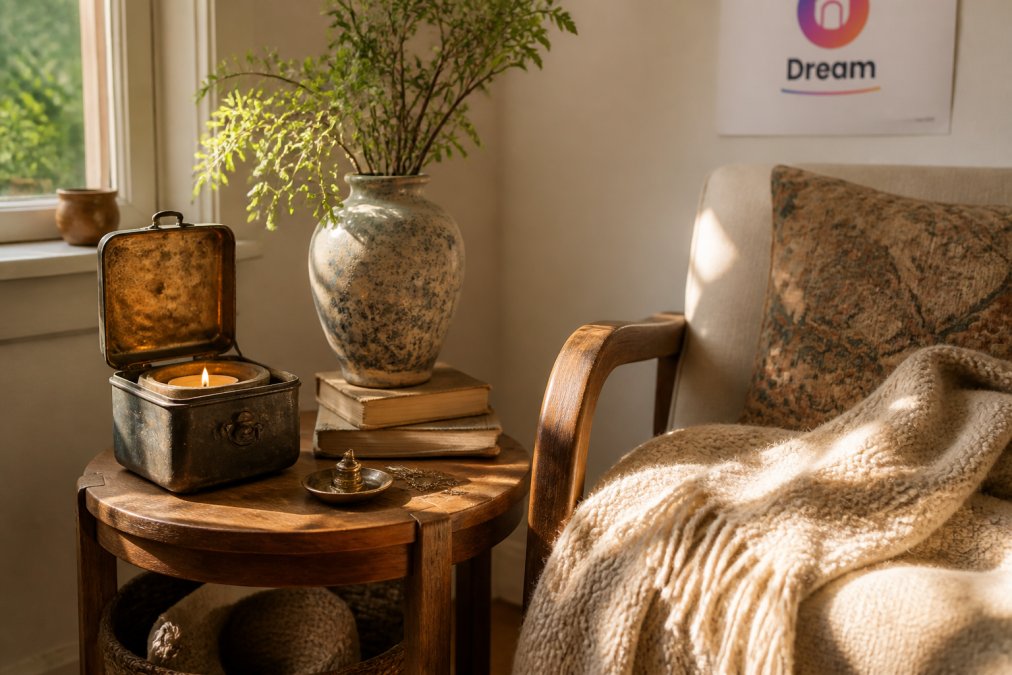
Small accents are where budget curation pays off fastest. A scented aromatherapy pillar candle in a soft colour adds warmth and a focal point for very little, and it works with Nordic, retro, or modern rooms. Hand-poured soy candles in a reusable iron box do double duty as decor and storage once the candle is finished. Layering scent, light, and texture this way makes a thrifted corner feel deliberate rather than accidental.

How to Curate Home Style in a Small Space
Small space curation follows one rule: every item must earn its footprint. In a compact room, clutter reads twice as fast, so editing matters more than adding.
- Go vertical. Use wall height for shelves, art, and hooks instead of floor space.
- Choose multi-use pieces. A storage ottoman is seating and storage at once.
- Keep the palette tight. Fewer colours make a small room feel larger.
- Leave negative space. Empty surface area is a design choice, not a gap to fill.
- Scale down, don't crowd. One large artwork beats six small frames on a narrow wall.
Conclusion: Start Curating Today
The hardest part of curation is starting, because it means removing things you paid for. But a home that reflects your taste is built by subtraction first and addition second. Dream Deal Shop stocks hand-picked home and lifestyle pieces at real discounts, from scented soy candles to decor accents, with new drops added daily. Once a deal sells out, it's gone, so it pays to check back often.
Frequently Asked Questions
What is the difference between styling and curating a home?
Styling is arranging what you already own: fluffing cushions, restacking books, moving a vase. Curating is the step before that: choosing which pieces earn a place in your home at all. A curated home has a clear point of view, so every object supports the same look. Styling without curation is why rooms can feel busy yet unfinished. Start by removing anything that does not fit your palette, then style what remains.
How do I make my home look curated instead of cluttered?
Declutter first, then group. Clear every surface completely, then put back only the pieces you genuinely like, arranged in odd-numbered groups of three or five. Give each group one focal point and two supporting pieces. Keep at least one-third of every shelf and countertop empty. The 3-5-7 rule works well here: group decor in threes, fives, or sevens of varying heights and textures so the eye has a clear path.
How do you mix different design styles without it looking messy?
Pick one style as your base and treat the second as an accent. If your base is modern, add one vintage or antique piece per room, not five. Repeat two or three colors and one material, such as wood or brass, across both styles so they share a thread. Keep proportions in check: a heavy antique chest needs a lighter chair beside it. The 80/20 rule helps: roughly 80 percent of a room in one style, 20 percent in the other.
What makes a home look cheap, and how do I avoid it?
Matching furniture sets, bare walls, harsh overhead lighting, and too many small knick-knacks are the usual culprits. Visible cables, empty shelves, and decor that is all one height or texture also flatten a room. Fix it by layering textures, adding one large piece of art instead of many small ones, and using warm lamps at two or three heights. A scented candle or two adds warmth without cost, and a single well-chosen vintage item lifts a whole corner.