


Essential Home Repair Tools for New Homeowners
Last Updated: November 4, 2026
Quick Summary
Start your home repair tools with five hand tools: a claw hammer, tape measure, adjustable wrench, multi-bit screwdriver and utility knife. Add a cordless drill and stud finder next, then buy other power tools only when a project demands them.
- A 5-metre retractable tape measure covers furniture placement and shelf spacing.
- Choose a 12V drill for light jobs or 18V for more torque.
- Keep one battery platform so a single charger fits every cordless tool.
- Store hand tools in a dry cupboard, since damp basements and sheds invite rust.
- First-time Dream Deal Shop customers get 10% off their first order.
Table of Contents
- Start With the Essential Hand Tools for Home Repair
- Which Power Tools a New Homeowner Actually Needs
- Measuring, Marking and Fastening Tools That Save Rework
- Home Repair Tool Storage Ideas That Keep Everything Findable
- Budget vs Professional Grade: Where to Spend and Where to Save
- Your Basic Home Maintenance Checklist for the First Year
- Keep Your Tools Working: Maintenance and Safety for Beginners
- Build Your Kit One Drop at a Time
- Frequently Asked Questions
Start With the Essential Hand Tools for Home Repair
Most new homeowners buy too much too fast. The smarter move is to start with a small core of hand tools that covers the jobs you will actually face in your first year: hanging shelves, tightening a loose tap, assembling flat-pack furniture, and patching a squeaky hinge.
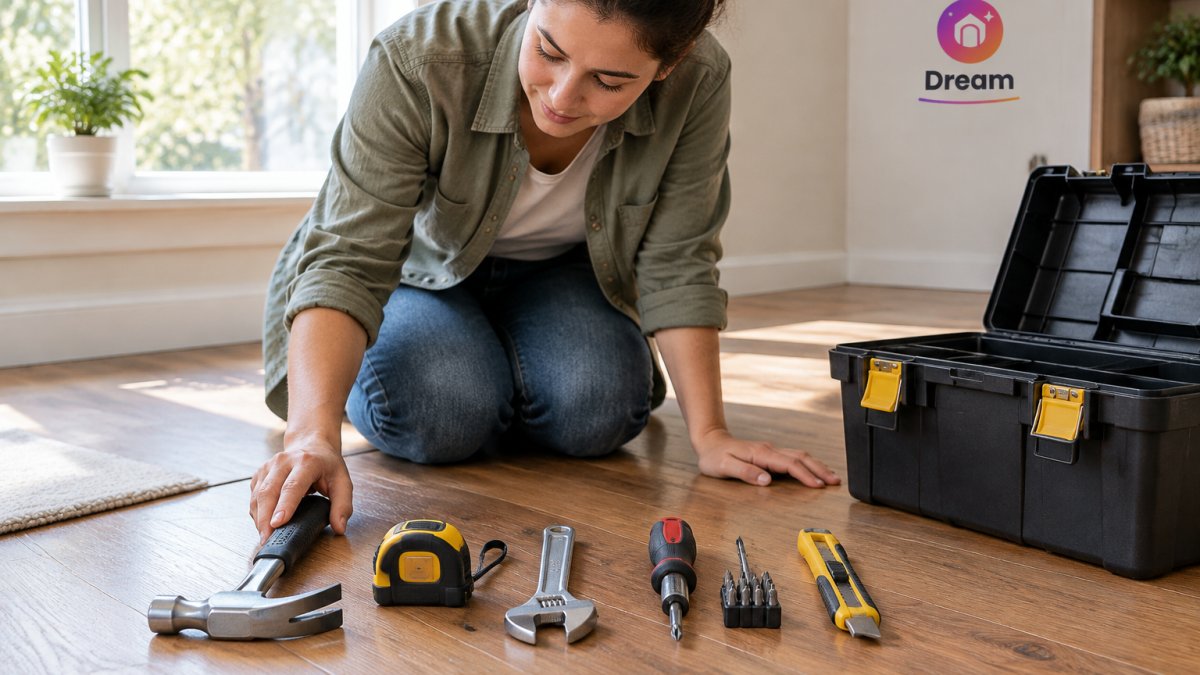
A hand tool is any tool powered by your own effort rather than a motor, and it is the foundation of every starter kit. A claw hammer, tape measure, adjustable wrench, multi-bit screwdriver, and utility knife handle the majority of small household fixes.
The Five Tools You Will Reach For Weekly
- Claw hammer - for hanging pictures, tapping in nails, and pulling them back out.
- Tape measure - a 5-metre retractable one covers furniture placement and shelf spacing.
- Adjustable wrench - one tool that fits most nuts and bolts around the house.
- Multi-bit screwdriver - swap between Phillips, flathead, and square bits without hunting for a second tool.
- Utility knife - opens boxes, trims cardboard, and cuts tape during moves and deliveries.
Pliers, Wrenches and Hex Keys: The Grab-and-Go Layer
Once the basics are in place, add a second layer you can grab without thinking: needle-nose pliers for tight spots, hex keys for furniture bolts, and a small level for straight frames. These are the essential hand tools for home repair that quietly prevent rework, because a crooked shelf or stripped bolt costs far more time than the tool would have.
Watch out: skipping a level and eyeballing shelf placement is the most common beginner mistake. A cheap bubble level saves you from patching and re-drilling holes later.
Which Power Tools a New Homeowner Actually Needs
You need one power tool first: a cordless drill. It drives screws, drills pilot holes, and with the right bit set, handles most assembly and mounting jobs. Everything else can wait until a specific project demands it.
A cordless drill is a battery-powered tool that rotates drill bits and driver bits, and it replaces hours of manual screwdriving. A stud finder is the other early purchase worth making, since it helps you locate safe mounting points before you drill.
What to Look For in a First Drill
Most new homeowners are best served by a 12V or 18V cordless drill-driver.
A drill bit set matters as much as the drill. You need twist bits for wood and metal, plus a set of driver bits in Phillips, flathead, and square drive to match the screws that come with flat-pack furniture and hardware.
Watch out: driving a screw without a pilot hole in hardwood or near an edge splits the wood. Drill a pilot hole slightly narrower than the screw shank first.
The Second-Wave Power Tools
Add these only when a real project calls for them:
- Power sander, for smoothing patched drywall, refinishing a table, or prepping trim before painting.
- Jigsaw, for curved cuts in plywood, notching shelf boards, or trimming a door bottom. It is safer for beginners than a circular saw because the blade reciprocates rather than spins.
- Oscillating multi-tool, for flush cuts, sanding in tight corners, and scraping. It is the tool most often borrowed once and then bought.
- Circular saw, only when you start cutting sheet goods or framing lumber. It demands more care with kickback and blade guards than a jigsaw.
You do not need a full workshop in month one. Let the project list decide what comes next.
Battery Platform: The Decision That Sticks
Once you own two cordless tools, staying within one battery platform saves money and clutter. A shared battery platform means one charger and a set of batteries that fit every tool. This is a budget decision as much as a convenience one, and it is the kind of value judgment our guide to finding durable home essentials on a budget explores in more detail.
Measuring, Marking and Fastening Tools That Save Rework
Precision is what separates a job that looks finished from one that looks attempted. A tape measure, a pencil, a small square, and a level form your measuring and marking kit.
Fasteners deserve their own small box. A hardware kit with assorted screws, wall anchors, and nails in a few common sizes means you are not driving to the shop for a single screw.
| Task | Tool to reach for | Why it matters |
|---|---|---|
| Hanging a frame | Tape measure, level, stud finder | Straight placement, secure mounting |
| Assembling furniture | Hex key set, multi-bit screwdriver | Matches the bolts included in flat-pack kits |
| Tightening a tap | Adjustable wrench | Fits varied nut sizes without a full set |
| Opening deliveries | Utility knife | Clean cuts, less mess |
Home Repair Tool Storage Ideas That Keep Everything Findable
Good storage is the difference between a five-minute fix and a twenty-minute search.
Space-saving solutions matter in small homes. Cables and chargers deserve their own home too, and a cable and wire storage box keeps power strips and adapters tidy.
Replacement Microfibre Mop Head for Vileda Turbo 2-in-1 | Spin Mop Refill →
Watch out: storing tools in a damp basement or shed invites rust. Keep hand tools in a dry cupboard and wipe metal surfaces after outdoor use.
Budget vs Professional Grade: Where to Spend and Where to Save
Spend on the tools you use weekly; save on the ones you use twice a year. A cordless drill and a good tape measure earn their price through constant use.
Professional-grade tools are built for heavier daily use, but a new homeowner rarely needs that durability on day one. Buy mid-range for the core kit, then upgrade a single tool once you notice it letting you down.
Your Basic Home Maintenance Checklist for the First Year
A basic home maintenance checklist is a short seasonal list of checks that catch small problems before they become expensive ones. Run through it monthly for the first year and you will learn your home's quirks fast.
- Test smoke and carbon monoxide detectors
- Check under sinks for slow leaks
- Clear drains and fit a hair catcher in the shower
- Tighten loose cabinet hinges and handles
- Inspect caulk around windows and wet areas
- Clean or replace HVAC filters
Floor care belongs on that list too. A replacement microfibre mop head lets you refresh a spin mop instead of replacing it, which fits the first-year mindset of maintaining what you already own.

Keep Your Tools Working: Maintenance and Safety for Beginners
Most tool guides stop at what to buy. Two things keep a starter kit useful for years: a simple maintenance routine and a few safety habits learned before the first project. Both prevent the two most common new-homeowner regrets, rusty, dull tools and a preventable injury.
A Five-Minute Maintenance Routine
Tools last longer with a little care. Wipe metal surfaces with a light oil after use, keep drill batteries out of extreme heat, and sharpen or replace utility knife blades rather than forcing a dull one. Calibration matters for measuring tools: drop a level once and it may no longer read true, so check it against a known flat surface.
A workable routine:
- After every job: wipe metal tools with a lightly oiled cloth, brush sawdust out of drill chucks and bit cases, and retract the utility knife blade.
- Monthly: check the level against a door frame or countertop edge; if the bubble drifts, replace it. Inspect hammer handles and screwdriver tips for cracks or rounding.
- Seasonally: clean and oil hinges on loppers and pruners, check that drill batteries still hold a charge, and clear rust spots with fine steel wool before they spread.
- Storage: keep hand tools in a dry cupboard, not a damp basement or shed. A closed toolbox with a silica gel packet absorbs moisture in humid months.
Safety Habits for First Projects
Safety for beginners comes down to a few habits that become automatic fast. Wear safety goggles when drilling or cutting, use work gloves when handling rough materials, and clamp your work with a C-clamp so both hands stay free. A step stool beats a chair every time you reach for a high shelf.
Beyond the basics:
- Drilling: know what is behind the wall before the bit goes in. Read the manual for how your stud finder signals studs, pipes and wiring. Keep your hand clear of the chuck and let the bit cool between long runs.
- Utility knife: cut away from your body, score in several light passes rather than one deep push, and change the blade the moment it starts to drag. A dull blade needs more force and slips more often.
- Saws and cutting: clamp the workpiece, keep the blade guard in place, and never reach across a running blade. Let the tool come to a full stop before setting it down.
- Ladders and reaching: keep three points of contact on a ladder, and do not stand on the top rung. For high shelves, a step stool with a handrail is steadier than a chair.
When to Repair and When to Replace
A little maintenance extends tool life, but some wear signals replacement. A screwdriver tip that rounds off will strip screws; a hammer with a loose head is a hazard; a drill battery that no longer holds a charge past a few minutes is usually past saving. Replacing a worn consumable, a utility knife blade, a drill bit, a mop head, is almost always cheaper than replacing the whole tool.
Build Your Kit One Drop at a Time
You do not need to furnish a whole workshop before your first weekend in the house. Buy the core hand tools, add a drill, and let real projects tell you what comes next.
At Dream Deal Shop, we stock practical home essentials at real discounts, with new hand-picked drops every day.
Get started with Dream Deal Shop and build a tool kit that grows with your home.
Frequently Asked Questions
What are the most important tools for a first-time homeowner?
Start with a claw hammer, tape measure, adjustable wrench, multi-bit screwdriver, utility knife, pliers and a level. These cover hanging shelves, tightening fittings, assembling flat-pack furniture and basic fixes. Add a cordless drill once you have a project that needs one. Buying a small core of home repair tools first, then adding as jobs come up, keeps the spend low and means you only own what you actually use.
Should I buy a tool kit or individual tools?
A pre-packed kit is the faster route and usually cheaper upfront, but check what is inside. Many kits pad the count with tiny bits you will never touch. If you want quality where it counts, buy the five or six essential hand tools for home repair individually and fill gaps later. Either way, add storage you can see into, so you know what you have before buying a duplicate.
How do I store my home repair tools efficiently?
Group tools by job rather than by type: a plumbing pouch, an electrical pouch, a hanging-and-fixing pouch. Keep the everyday set in a shallow open tray or toolbox you can carry in one hand, and store rarely used items higher up. Home repair tool storage ideas that work in small spaces include wall-mounted rails, under-sink caddies and labelled clear boxes. A cable and wire storage box also keeps chargers and power strips from tangling with your tools.
Are power tools necessary for new homeowners?
Not on day one. A cordless drill is the first power tool worth owning because it handles pilot holes, shelf brackets and furniture assembly faster than a screwdriver. Everything else can wait until a specific project calls for it. Borrow or rent specialist power tools for one-off jobs, and put the savings toward the hand tools and safety gear you will use every month.
