

Affordable Daily Essentials for Home: 2026 Guide
Table of Contents
- Why Affordable Daily Essentials for Home Matter in 2026
- Best Affordable Home Kitchen Tools That Earn Their Counter Space
- Budget-Friendly Home Organization Hacks for Every Room
- How to Save Money on Household Essentials Without Buying Junk
- Cleaning and Laundry Consumables: Where the Real Savings Hide
- Home Safety and Maintenance Items You Should Not Skip
- Cost-Per-Use: The Math That Separates Cheap From Affordable
- Conclusion: Build Your Home Essentials List Around What You Replace Most
- Frequently Asked Questions
Last Updated: September 17, 2026
Why Affordable Daily Essentials for Home Matter in 2026
Building an affordable daily essentials for home list is less about chasing bargains and more about buying things you will still use in three years. This guide from Dream Deal Shop focuses on items that earn their place through daily use, not novelty. A common mistake is buying the cheapest version of something you touch every day: the grinder that jams, the jar that does not seal, the organiser that sags.
Best Affordable Home Kitchen Tools That Earn Their Counter Space
Counter space is the real budget in a kitchen. Any tool that takes up room has to justify itself every week, or it becomes clutter you move aside to reach the kettle.
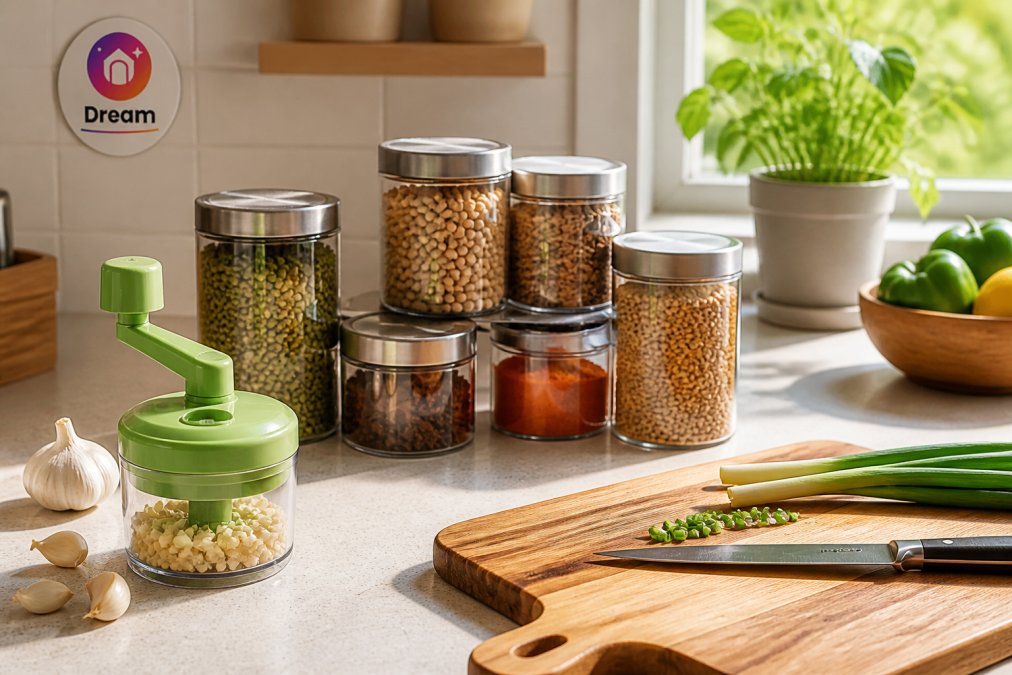
Manual Tools That Beat Their Electric Counterparts
Garlic presses, citrus reamers, and simple hand choppers all fall into this group. They cost less, break less often, and store in a drawer. The trade-off is speed on large batches, which rarely matters in a home kitchen.
Storage Jars That Cut Food Waste and Grocery Runs
Airtight storage is one of the few home purchases that pays you back twice: less spoiled food, fewer emergency grocery trips. Sealed kitchen storage jars in the 460ml to 1800ml range cover most pantry needs, from spices up to bulk grain.

Budget-Friendly Home Organization Hacks for Every Room
Good organisation is mostly about removing friction, not buying more containers. The cheapest fixes are the ones that stop clutter accumulating in the first place. But there is a second principle most general lists miss: in a small home, every item has to justify its footprint, not just its price. A cheap bin that wastes a shelf is more expensive than a slightly pricier one that uses the space properly.
Small-Space Storage That Actually Holds Up
Small-space optimisation is where cheap storage fails most often. Flimsy bins crack, wire racks bend, and cardboard boxes sag within a season. The fix is to buy for footprint efficiency, not just low price.
- Vertical over horizontal. A stackable, recessed-lid jar or a tiered organiser uses height that is otherwise wasted. A wide, shallow bin uses floor or shelf space you cannot get back.
- Modular over fixed. Snap-lock compartments and stackable units let you reconfigure as needs change, so you are not buying a new system every time your storage needs shift.
- Visible over hidden. Clear jars and open-front organisers let you see what is running low before you leave for the shop, which cuts duplicate purchases.
Desk and Cable Clutter: The 15-Minute Fix
Cable tangle is the fastest win in any home office. A freestanding cable and wire storage box hides a power strip and adapters while keeping outlets reachable, and it needs no assembly. Fifteen minutes and the desk reads as tidy.
How to Save Money on Household Essentials Without Buying Junk
Saving money on household essentials comes down to three habits: buy consumables in the right quantity, buy durable goods once, and refuse to replace the same item twice.
- Set a restock rhythm. Note how long each consumable actually lasts, then buy to that cycle instead of panic-buying.
- Check the refillable option. Reusable containers and refill packs cut packaging cost over a year.
- Read the material, not the marketing. Thickened PET, PA+PE, and metal-bodied tools outlast thin alternatives by a wide margin.
- Ignore the multi-pack trap. A three-pack of something you use twice a year is not a saving, it is storage you are paying for.
Cleaning and Laundry Consumables: Where the Real Savings Hide
Cleaning supplies and laundry care are the categories where most households overspend without noticing. The spend is small per item and constant, which is exactly why it adds up.
Sealed Kitchen Storage Jars Set →
Home Safety and Maintenance Items You Should Not Skip
Home safety items are the ones people delay because nothing has gone wrong yet. That is precisely the wrong reason to skip them. But a list of items is not a plan. What most households lack is a schedule: a fixed cadence for checking, replacing, and restocking the things that protect the home. Without one, safety gear quietly expires and small maintenance issues become expensive repairs.
Monthly Checks (Ten Minutes)
- Smoke and carbon monoxide alarms. Press the test button on each unit. Most manufacturers recommend this monthly, and it catches a dead battery before it matters. Replace the batteries on a fixed date each year, such as when clocks change, so you cannot forget.
- Fire blanket and extinguisher. Confirm the blanket is still sealed and the extinguisher gauge is in the green. A fire blanket that has been opened and refolded may not deploy cleanly.
- Torch and emergency lighting. Switch on the torch and any rechargeable lamps. A torch that has sat unused for a year is often flat when you need it.
Quarterly Checks (Thirty Minutes)
- Water shut-off valves. Turn each valve a quarter-turn and back. Valves that never move seize up, and a seized valve turns a small leak into a flooded room. This is the single highest-value maintenance habit in the house.
- Window and door seals. Run a hand around frames on a windy day. Draughts mean heat loss in winter and higher bills. Replacing worn brush or rubber seals is cheap; ignoring them is not.
- Gutter and downpipe clearance. Clear leaves and debris before the rainy season. Blocked gutters push water into the roof and foundation, which is where the expensive damage starts.
Annual Checks (One Afternoon)
- Boiler or heating service. Most manufacturers require an annual service to keep the warranty valid. Book it before winter, not during the first cold snap when engineers are fully booked.
- Replace alarm units. Smoke and CO alarms have a working life of around ten years, printed on the unit. After that, the sensor degrades even if the test button still beeps.
- Restock the first aid box. Check expiry dates on sterile items and replace anything used. A first aid box is only useful if it is complete.
Maintenance follows the same logic as the rest of this guide. These are durable goods doing quiet work, and they are among the most cost-effective purchases in the house because they prevent the expensive failure rather than fixing it. A ten-pound valve that turns freely is worth more than a hundred-pound repair after a leak.
Cost-Per-Use: The Math That Separates Cheap From Affordable
Cost-per-use is the purchase price divided by the number of times you will actually use the item. It is the single most useful number in household budgeting, and almost nobody calculates it.
| Item | Typical Price | Uses Per Year | Cost Per Use (Year 1) |
|---|---|---|---|
| Manual garlic press | £9.99 | 150 | £0.07 |
| Sealed kitchen storage jars set | £31.29 | 365 | £0.09 |
| Vacuum storage bags (5-pack) | £13.99 | 10 | £1.40 |
| Cable & Wire Storage Box | £43.99 | 365 | £0.12 |
| Drain Deodorizer Scented Gel | £24.99 | 60 | £0.42 |
Conclusion: Build Your Home Essentials List Around What You Replace Most
The tension in every household budget is the same: you want durable goods that last and low prices, and those two pull against each other. Resolve it by category. Spend on the things you touch daily, save on the things you use twice a year, and never buy the same item twice because the first one was flimsy.

Frequently Asked Questions
What are some daily essentials for a home that people always forget?
Most lists cover kitchen and cleaning basics but skip the items you replace constantly: drain catchers, cable organizers, and airtight containers for opened dry goods. A silicone floor drain hair catcher costs under 18 and prevents a plumbing call-out that runs far more. Write down what you rebuy every month, then build your list from that. Those repeat purchases are your real daily essentials for home.
How can I stock my home essentials on a budget without buying low-quality items?
Buy fewer items but check the specifications first. A 5-pack of vacuum storage bags at 13.99 compresses bedding by up to 80%, which frees closet space you would otherwise rent storage for. Compare cost per use rather than sticker price: a 9.99 manual garlic press that lasts three years beats a 25 electric one that dies in six months. Set a monthly essentials budget and stick to it.
Are affordable home kitchen tools worth buying, or should I spend more?
Price and durability are not the same thing. A compact manual garlic grinder at 9.99 weighs 27g, handles peeling and mashing, and has no motor to fail. Sealed kitchen storage jars from 460ml to 1800ml keep grain and spices moisture-free using a silicone sealing ring, which extends shelf life and cuts food waste. Spend more only where a motor or blade does work you cannot replicate by hand.
What are the top 10 useful household items for a small home?
Prioritise items that solve two problems at once. Stackable desk organizers handle stationery and makeup. Vacuum bags with a hand pump work without a power outlet. A cable and wire storage box hides power strips while keeping outlets reachable. Drain deodorizer gel pods in packs of 30, 60, or 90 handle odours without harsh chemicals. Storage jars that stack without wobbling save shelf space. Pick ten items you will use weekly, not annually.