


How to Pick Essential Baking Tools for Beginner Home Bakers
Last Updated: October 31, 2026
Quick Summary
Essential baking tools for beginner home bakers come down to a short list: something to measure with, something to mix in, something to bake on, and something to lift it out with. Buy one of each pan you'll actually use rather than a full set, then add pieces as your recipes demand them.
- A 20 cm round cake tin, a standard loaf tin, and a rimmed baking sheet cover nearly every beginner recipe.
- Two matching cake tins are worth more than four mismatched ones because layer cakes need identical pans.
- A cup of all-purpose flour can weigh anywhere from about 120 g to 150 g depending on how you fill it.
- Weigh flour, sugar, and butter for cookies and cakes, and weigh everything including water for bread.
- Skip stand mixers, food processors, piping sets, springform pans, and flour sifters when you're starting out.
Table of Contents
- Start with the Basic Baking Equipment Every Kitchen Needs
- Baking Tools for Cakes and Cookies: What Earns Counter Space
- How to Choose Baking Pans by Material, Size, and Recipe
- Baking Tools You Can Skip (At Least for Now)
- Scale Versus Cups: Getting Ingredient Measurement Right
- How to Use and Care for Your Baking Tools So They Last
- Build Your Starter Kit with Dream Deal Shop
- Frequently Asked Questions
Start with the Basic Baking Equipment Every Kitchen Needs
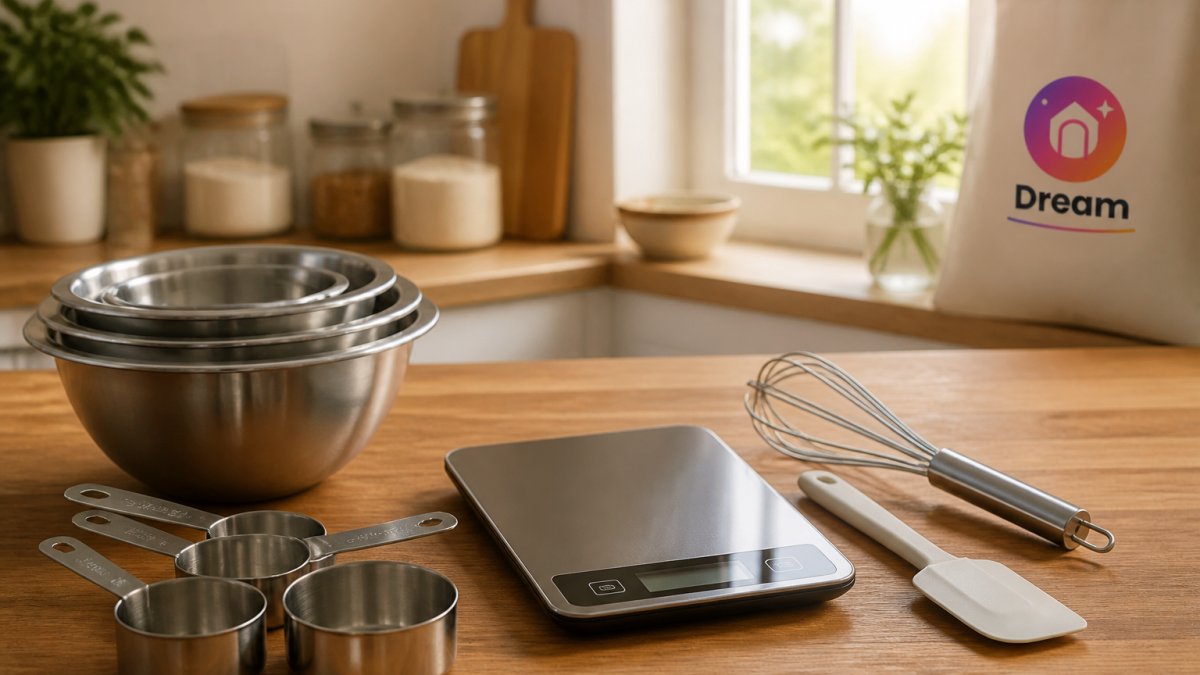
Essential baking tools for beginner home bakers come down to a short list: something to measure with, something to mix in, something to bake on, and something to lift it out with. Everything else is optional.
If you've priced out a "complete" baking set, you already know how fast the list grows. Most of it you won't touch for months.
Measuring Tools: Cups, Spoons, and a Digital Scale
Measuring tools are where beginners overspend and underperform at the same time. You need one set of dry measuring cups, one set of measuring spoons, and a scale. That's it.
A scale is not a luxury. If you want to measure small amounts with control, a digital measuring spoon scale handles yeast, cocoa, and spices far better than a spoon and a guess.

Mixing Bowls, Whiskes, and Spatulas
Three bowls, one whisk, one sturdy spoon, one spatula. Nesting bowls save cabinet space, which matters more than most guides admit.
A spatula is the tool people forget and then miss constantly. It scrapes the bowl clean, folds batter without deflating it, and gets every last bit of dough out. A silicone utensil set with spatulas, scrapers, and a pastry brush lets you buy the mixing station in one go.

Baking Tools for Cakes and Cookies: What Earns Counter Space
Cookies and simple cakes are the right starting point for a beginner baker, and they need surprisingly little equipment. One flat baking sheet, one round cake tin, one loaf tin, and a wire rack will carry you through most beginner recipes.
Cake Tins, Loaf Tins, and Baking Sheets
Buy one of each, not a set. A 20 cm round cake tin, a standard loaf tin, and a rimmed baking sheet cover nearly every beginner recipe.
Skip non-stick coatings that scratch easily and skip novelty shapes. Two matching cake tins are worth more than four mismatched ones, because layer cakes need identical pans to bake evenly. If you bake cookies more than cakes, buy a second sheet pan before you buy anything else.
Rolling Pin, Parchment, and Cooling Rack
A plain wooden rolling pin, a roll of parchment paper, and a wire cooling rack. That's the finishing kit, and each piece earns its spot.
The cooling rack is not optional. Cookies left on a hot sheet keep baking from residual heat and go soft on the bottom. A non-stick silicone pastry mat with printed measurement circles can stand in for parchment when rolling dough, and it wipes clean afterward.

How to Choose Baking Pans by Material, Size, and Recipe
Match the pan to the recipe, not the other way around. That single rule prevents most beginner baking failures, and it's the angle most beginner guides skip: they list pan types, but they don't tell you which pan a cookie, a cake, a loaf, or a pastry actually needs.
Start with the recipe you plan to bake
- Cookies: one rimmed baking sheet, light-colored metal. Dark sheets brown the bottoms before the centres set.
- Layer cakes: two identical round tins, 20 cm (8 in) is the most common beginner size. Identical pans bake evenly; mismatched pans don't.
- Loaf cakes and quick breads: one standard loaf tin, about 23 x 13 cm (9 x 5 in). Most banana bread and pound cake recipes are written for this size.
- Muffins and cupcakes: one 12-cup muffin tin. Silicone liners or paper liners save cleanup.
If you bake cookies more than cakes, buy a second sheet pan before you buy anything else. If you bake cakes more than cookies, buy the second cake tin first.
Material trade-offs that actually change results
- Light-colored metal pans: the safest default. They brown evenly and forgive a slightly hot oven.
- Dark non-stick pans: brown faster. Drop your oven temperature by about 10 to 15°C and check early.
- Glass dishes: good for loaves and casseroles, slower to heat, so expect longer bake times and a darker crust.
- Silicone molds: fine for muffins, poor for anything that needs a crisp crust.
Sizing matters just as much. A recipe written for a 20 cm tin will not behave the same in a 23 cm one, because the batter spreads thinner and bakes faster.
If you'd rather buy the finishing pieces together, a non-stick silicone pastry mat with printed measurement circles replaces parchment for rolling dough and wipes clean afterward, which makes it a good swap in a small kitchen. Hand wash it and keep knives off the surface.
Watch out: cheap non-stick pans that flake after a few washes cost more in replacements than one decent pan. Buy fewer, better pieces.
Here's the short version of which pan each beginner recipe actually needs.
Silicone Kitchen Utensil Set – 6-Piece Spatula & Baking Tools →
| Recipe | Pan to buy | Size or note |
|---|---|---|
| Cookies | One rimmed baking sheet, light-colored metal | Dark sheets brown bottoms too fast |
| Layer cakes | Two identical round tins | 20 cm (8 in) is the common beginner size |
| Loaf cakes and quick breads | One standard loaf tin | About 23 x 13 cm (9 x 5 in) |
| Muffins and cupcakes | One 12-cup muffin tin | Silicone or paper liners save cleanup |
| Pies and tarts | A 23 cm (9 in) pie dish | Glass is common; you can see browning |
| Pastry and rolled dough | Flat surface and a rolling pin | Matter more than the pan |
Baking Tools You Can Skip (At Least for Now)
Stand mixers, food processors, piping sets, springform pans, and flour sifters all show up on beginner lists.
A hand whisk and a sturdy spoon handle most mixing. A sieve does the sifting job for less money and less cabinet space.
The trap is buying a full kit before you know your own habits. For a deeper list of affordable home kitchen tools that last, see our picks.
Watch out: cheap non-stick pans that flake after a few washes cost more in replacements than one decent pan. Buy fewer, better pieces.
Scale Versus Cups: Getting Ingredient Measurement Right
Weighing ingredients is more accurate than measuring by volume, and for flour it's not close. A cup of all-purpose flour can weigh anywhere from about 120 g to 150 g depending on whether you scoop, spoon, or sift it.
The practical approach is a hybrid, and it depends on what you're baking:
- Cookies and cakes: weigh flour, sugar, and butter. These recipes are sensitive to small ratio changes.
- Bread: weigh everything, including water. Hydration is the whole game, and a few grams off changes the crumb.
- Pastry and pie dough: weigh flour and fat. The fat-to-flour ratio decides whether the crust is flaky or tough.
- Small amounts: use measuring spoons for yeast, salt, baking powder, and extracts. The difference won't change the outcome, and spoons are faster.
A few habits make either method more reliable:
- Spoon flour into the cup and level it off; never scoop straight from the bag.
- Use the tare function so the bowl's weight doesn't count.
- Stick to one system per recipe rather than converting mid-bake.
- Weigh liquids when a recipe gives grams; a liquid measuring cup is fine when it gives millilitres.
A digital measuring spoon scale is a useful middle ground for yeast, cocoa, and spices, because it measures small amounts with control that a spoon and a guess can't match. Your recipe's own numbers are the best guide.
How to Use and Care for Your Baking Tools So They Last
Care is the difference between a set that lasts years and one that's scratched and warped by spring. None of it takes long.
- Wash silicone and metal by hand in warm soapy water; the dishwasher dulls finishes
- Dry metal pans fully before stacking to prevent rust spots
- Never cut on a silicone mat or a non-stick surface
- Store pans with a cloth or paper towel between them
- Keep your scale away from heat and water; wipe, don't soak
Watch out: putting a hot pan straight into cold water can warp it. Let it cool on the stovetop first.
For general food safety guidance, the FDA's food handling resources are worth a read.
Build Your Starter Kit with Dream Deal Shop
A starter kit doesn't need to be big. Measuring cups, spoons, a scale, three bowls, a whisk, a spatula, one sheet pan, one cake tin, one loaf tin, parchment, and a cooling rack.
At Dream Deal Shop, we hand-pick home essentials and drop them at real discounts, and once a deal sells out it's gone. Browse our Home Essentials collection to fill out the rest of your setup.
Frequently Asked Questions
What baking tools does a beginner really need?
Start with measuring cups and spoons, a digital scale, two mixing bowls, a whisk, a spatula, one baking sheet, one round cake tin, parchment paper, and oven mitts. That covers most cookies, cakes, and simple breads. Add a loaf tin, rolling pin, and cooling rack as your recipes call for them. You do not need a stand mixer, piping set, or specialty tins on day one. Buy the basics first, then expand based on what you actually bake.
Are measuring cups or a kitchen scale better for baking?
A digital scale gives more accurate measurements, especially for flour, which can vary a lot when scooped with a cup. Cups and spoons still work well for small amounts and for recipes written in volume. Many beginners use both: a scale for flour, sugar, and butter, and cups for liquids and tiny quantities. A digital measuring spoon scale is a handy middle ground for small ingredients like yeast, cocoa, or powdered sugar.
Can you start baking without a stand mixer?
Yes. A sturdy spoon, a whisk, and a bit of arm work handle most beginner recipes, including cookies, muffins, and simple cakes. A stand mixer saves time for stiff doughs and long creaming steps, but it is not essential at the start. If you bake often and your recipes call for creaming butter and sugar for several minutes, an electric hand mixer is a cheaper first upgrade than a stand mixer.
Which baking tools are worth buying first?
Prioritize tools you will use in almost every recipe: measuring cups and spoons, a digital scale, mixing bowls, a whisk, a spatula, a baking sheet, a round cake tin, parchment paper, and oven mitts. These cover cookies, cakes, and quick breads. Add a loaf tin and rolling pin once you branch into breads and pastry. Skip piping bags, specialty molds, and multiple pan sizes until a specific recipe demands them.
The hardest part of learning to bake isn't technique. It's starting with tools that fight you. We keep our home essentials collection small and practical on purpose, with daily drops on the items people actually use, and 10% off your first order to make the first step cheaper. Get started with Dream Deal Shop and build a baking kit you'll still be using next year.
