

Best Budget-Friendly Kitchen Essentials 2026
Table of Contents
- What Makes a Kitchen Essential Truly Budget-Friendly in 2026
- How to Build a Budget Kitchen Starter Kit
- Best Kitchen Tools Under $50 That Earn Their Counter Space
- Essential Kitchen Appliances for 2026: What's Worth Buying
- Small Kitchen and Apartment Optimization: Making Every Centimetre Count
- Maintenance, Longevity, and Safety: Protecting Your Budget Buys
- Frequently Asked Questions
Last Updated: September 13, 2026
What Makes a Kitchen Essential Truly Budget-Friendly in 2026
The best budget friendly kitchen essentials 2026 are the ones used daily, not the ones that look impressive on a shelf. This Dream Deal Shop guide focuses on tools that earn their place through durability, versatility, and low price.
Budget-friendly kitchen essentials cost little upfront but deliver long-term value through frequent use and low replacement rates. A cheap gadget you use once is expensive; a €9 tool you reach for nightly is a bargain.
That distinction matters more than ever. Rising grocery costs have pushed more households to cook at home, and the USDA Economic Research Service food expenditure data shows food-at-home spending climbing steadily. When you cook more, your tools work harder. Cheap items fail fast.
The framework: buy fewer things, buy them well enough to last, and skip single-job gadgets.
How to Build a Budget Kitchen Starter Kit
A starter kit covers the four jobs every kitchen performs: cutting, heating, mixing, and storing. Start with what you already cook: if you make eggs every morning, a decent pan matters more than a blender; if you batch-cook on Sundays, storage containers top the list.
The Big 4 Foundation Tools You Actually Need
Four tools handle roughly 80% of everyday cooking: a chef's knife, a cutting board, one versatile pan, and a large mixing bowl. Buying these first avoids accumulating single-use gadgets.
- Chef's knife (20cm): the workhorse for chopping, slicing, and mincing. One good blade replaces three mediocre ones.
- End-grain or thick plastic cutting board: protects your knife edge and your countertop.
- Non-stick or stainless steel skillet (24-28cm): stainless steel offers better heat retention and searing; non-stick wins for eggs and fish.
- Large mixing bowl: for food prep, tossing, and serving.
A common mistake is buying a 12-piece knife block on sale, most blades never leave the block. Put that money into one knife you sharpen and maintain.
Storage and Organization Solutions That Save Space
Airtight storage keeps food fresh and frees counter space, since sealed containers stack, crucial in small kitchens.

Look for moisture-proof canisters with silicone sealing rings and recessed, stackable lids. Transparent material shows what you have before you buy duplicates, and sets from around 460ml to 1800ml handle spices, grains, and leftovers.
Best Kitchen Tools Under $50 That Earn Their Counter Space
The best kitchen tools under $50 are compact, multi-purpose, and easy to clean. These three cover prep, storage, and cleanup without taking over your drawers.
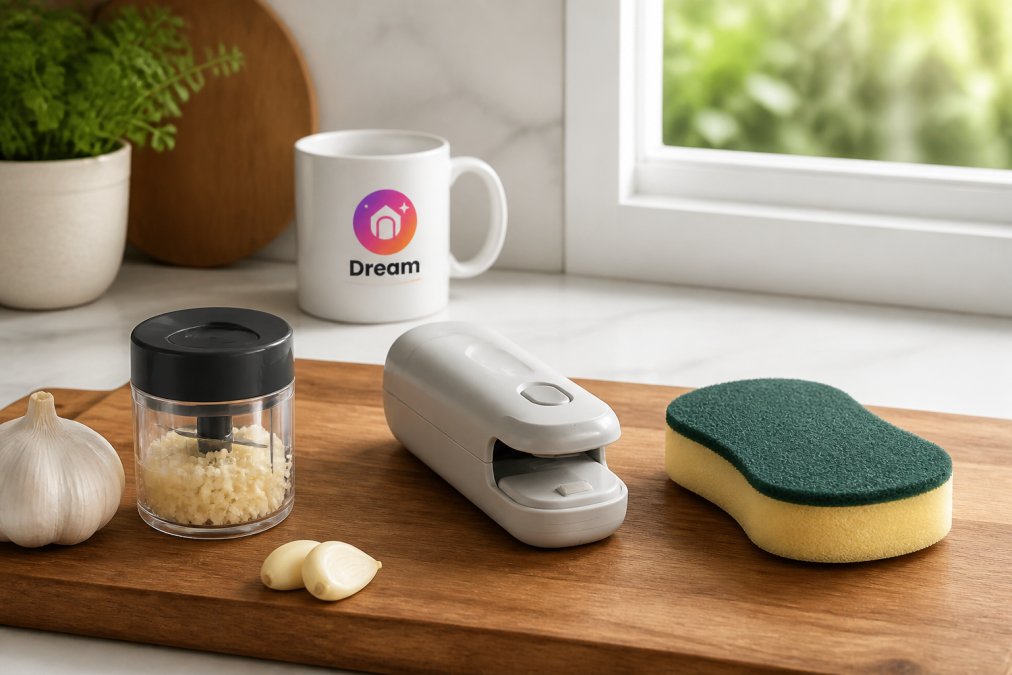
Prep Tools: Garlic Grinder, Bag Sealer, and More
A mini garlic grinder handles mincing and peeling in one compact tool, priced at €9.99. It lives in a drawer and is quick enough that you stop avoiding recipes calling for fresh garlic.

The mini heat bag sealer at €8.99 reseals snack and freezer bags, cutting food waste. One caveat: it needs a decent battery, cheap batteries are the top reason these devices underperform.
For cleanup, a double-sided sponge with a fiber scouring side tackles pots and stovetops without scratching. The 10-pack runs €17.99, and replacing a sponge beats scrubbing a burnt pan for twenty minutes.
| Tool | Price | Job It Replaces | Best For |
|---|---|---|---|
| Mini garlic grinder | €9.99 | Garlic press, peeler | Daily cooking |
| Mini bag sealer | €8.99 | Clips, elastic bands | Snack and freezer storage |
| Double-sided sponge | €17.99 | Scrubber plus cloth | Pots and stovetops |
Essential Kitchen Appliances for 2026: What's Worth Buying
Essential kitchen appliances for 2026 come down to three categories that genuinely change how often you cook: a multi-cooker, an air fryer, and an instant-read thermometer. Everything else, waffle irons, panini presses, countertop ice makers, is a hobby purchase.
The real decision is which appliance you will still plug in six months from now. That depends on counter space, jobs replaced, and whether the most fragile part is replaceable.
Multi-Cooker: One Unit, Two Appliances
A multi-cooker combines pressure and slow cooking in one housing, replacing two appliances and their cabinet space. The sealing valve and gasket matter more than the digital display: budget units fail at the gasket first, it hardens, stops sealing, and the unit under-pressurizes or refuses to come to pressure.
What to look for:
- 6-litre capacity is the practical sweet spot for two to four people. A 3-litre unit is too small for batch cooking; an 8-litre unit is heavy and slow to heat.
- Stainless steel inner pot, not non-stick. Non-stick inner pots scratch within a year of regular stirring, and replacement pots often cost half the price of the appliance.
- A replaceable gasket. Check that the manufacturer sells gaskets separately. If it does not, the appliance has a built-in expiry date.
A common pattern among budget multi-cookers is that the pressure function works fine but the sauté function runs weak. If you plan to brown meat in the same pot, look for a unit rated at least 900W on the sauté setting.
Air Fryer: Fast Heat, Small Footprint
An air fryer is a small convection oven with a fan mounted close to the heating element, which is why it preheats in two to three minutes instead of ten and roasts vegetables faster than a full-size oven. It is not frying, it is high-speed convection.
The trade-off is capacity. A 4-litre basket fits roughly two servings of fries or one small chicken. A 6-litre basket fits a family meal but takes up the footprint of a microwave. Measure your counter before you buy, not after.
Budget air fryers cut corners in three predictable places:
- Non-stick basket coating wears and flakes. A basket with a removable, dishwasher-safe insert lasts longer because you are not scrubbing the heating element side.
- The fan bearing gets noisy. A unit that rattles at month one will rattle louder at month twelve.
- The control panel is often the first electronic failure. Mechanical dials outlast touchscreens on cheap units.
Instant-Read Thermometer: The Cheapest Upgrade
An instant-read thermometer is the least expensive of the three and the one most home cooks skip. It removes guesswork from chicken, pork, and reheated leftovers, meaning fewer overcooked meals and less wasted food.
A budget digital thermometer reads in two to four seconds and is accurate to within about 1°C, enough for home cooking. What fails on cheap units is the thermocouple junction at the tip: it drifts over time, so a thermometer that reads 5°C low will tell you chicken is done when it is not. Test it in ice water (0°C) and boiling water (100°C at sea level) every few months.
The Counter-Space Math Most Guides Skip
Two large appliances on a small counter means you stop using one of them, the pattern most home cooks report after a year of ownership.
If your counter is under 60cm of usable depth, pick one large appliance and commit:
- Choose the multi-cooker if you batch-cook, make soups, stews, rice, or beans, and want one pot that does the work of two.
- Choose the air fryer if you mostly reheat, roast vegetables, or cook proteins quickly for one or two people.
- Choose neither if you have a full-size oven and limited space. A €15 thermometer plus a good sheet pan covers more ground than either appliance.
Where budget appliances fall short is build quality, not function: plastic housings crack at the hinge, non-stick coatings wear at the edges, and cheap thermocouples drift. Buy the simplest version you will use weekly, and check that wear parts, gaskets, baskets, probes, are sold separately.
Small Kitchen and Apartment Optimization: Making Every Centimetre Count
Small kitchens reward vertical storage and multi-purpose tools over anything decorative. A 20cm chef's knife uses less space than a knife block and does more, and a single stainless steel skillet replaces a non-stick pan, sauté pan, and roasting tray for most weeknight cooking.
Most budget kitchen guides list cheap tools but never explain how to fit them into 4 square metres of counter. Here is the practical version.
The Three Rules of Small-Kitchen Tool Selection
- One tool, three jobs. If a tool only does one thing, it has to be exceptional to earn its drawer space. A bench scraper cuts dough, moves chopped vegetables from board to pan, and cleans the counter. A garlic grinder minces, peels, and stores. A cast-iron skillet sears, bakes, and goes from stovetop to oven.
- Vertical beats horizontal. Every flat surface you free up is usable workspace. A magnetic knife strip on the wall replaces a knife block and a drawer insert. A rail above the splashback holds utensils, pans, and a cutting board.
- Stack, do not nest. Nesting bowls waste the vertical gap between them. Stacking containers with recessed lids use the full height of a cabinet shelf.
Multi-Functional Tools That Actually Earn Their Space
- Bench scraper (under €10): cuts, scoops, and cleans. Replaces a dough cutter, a spatula for moving chopped food, and a counter scraper.
- Cast-iron or carbon steel skillet (24-28cm): oven-safe, sears better than non-stick, and improves with use. One pan replaces two.
- Collapsible colander: folds flat when not in use. A rigid colander takes the same cabinet space as a stockpot.
- Foldable dish rack: dries flat against the wall or stores under the sink. A fixed rack permanently occupies a third of a small counter.
- Stacking airtight containers: see the storage section above. In a small kitchen, the container system is the pantry.
Vertical Storage That Costs Almost Nothing
- Wall-mounted rail above the splashback: holds utensils, small pans, and a cutting board. No drilling into tile if you use adhesive strips rated for the weight, check the rating before you hang anything heavy.
- Over-the-door cabinet organisers: turn a single cabinet door into storage for lids, cutting boards, or foil and wrap.
- Under-shelf baskets: clip onto an existing shelf and create a second tier for mugs, spices, or wraps.
- Magnetic knife strip: frees the drawer a knife block would occupy and keeps blades visible and dry.
A mini broom and dustpan set (€14.99) earns its place in a small kitchen because it stores in a narrow gap and handles crumbs without hauling out a full-size broom. That is the test for any small-kitchen purchase: does it store in a gap, or does it need a shelf?
The Longevity Angle: Buy Once, Keep It Small
The small-kitchen version of "buy it for life" is not about spending more. It is about owning fewer, better tools so you never need the storage space for replacements.
- Carbon steel and cast iron improve with use and can be re-seasoned indefinitely. A €30 carbon steel pan outlasts three €15 non-stick pans.
- Stainless steel and wood utensils do not melt, warp, or shed coating. They also do not scratch non-stick surfaces if you keep one non-stick pan for eggs.
- Glass and stainless storage does not stain, hold odours, or crack like cheap plastic. It stacks and it lasts.
The pattern is consistent: in a small kitchen, the cheapest tool is the one you never replace, because replacement means finding space for the new one while the old one is still there.
Maintenance, Longevity, and Safety: Protecting Your Budget Buys
Maintenance decides whether budget buys last five years or five months. The difference is rarely the product; it is how it is treated.
Knives: hand wash and dry immediately. Dishwasher heat and detergent dull edges and degrade handles. Hone weekly, sharpen every few months.
Non-stick pans: never preheat empty on high heat. Coating breakdown starts above the manufacturer's recommended maximum, and once it flakes, the pan is done. Use silicone or wood utensils.
Stainless steel: it survives almost anything, but heat distribution depends on a thick base. Thin stainless steel warps and develops hot spots.
Sealed containers: keep silicone gaskets clean and dry. A gasket with food residue stops sealing, and moisture gets in.
Safety and ergonomics deserve more attention than they get. An ergonomic handle reduces strain during long prep sessions, and a sharp knife is safer than a dull one because it does not slip off the food. Store blades in a block or on a magnetic strip, never loose in a drawer.
Frequently Asked Questions
What are the must-have kitchen essentials for 2026?
Start with the Big 4: a chef's knife, an end-grain cutting board, a non-stick skillet, and a stainless steel saucepan. Add a multi-cooker or air fryer for versatility, an instant-read thermometer for precision, and airtight storage jars for pantry organization. These budget kitchen essentials cover chopping, slicing, cooking, and storing without overspending. Focus on heat retention and ergonomic handles when choosing.
How do I stock a kitchen on a budget without buying junk?
Prioritize tools with heat retention and durable materials like stainless steel. Shop daily deal drops for cost-effective finds, and avoid single-use gadgets. A manual garlic grinder at €9.99 and a bag sealer at €8.99 replace multiple pricier tools. Check return policies before buying, and build gradually rather than all at once.
What are the best kitchen tools under $50 for a home cook?
A mini garlic grinder ($9.99), a portable heat bag sealer ($8.99), and a double-sided cleaning sponge set ($17.99) are all under $50 and handle prep, storage, and cleanup. For cookware, look for a non-stick skillet and a stainless steel saucepan.
How can I make a small kitchen more functional without spending much?
Use stackable airtight storage jars to save space and keep grains, spices, and pantry items moisture-proof. A self-draining soap dish keeps counters dry, and a mini broom and dustpan set handles quick cleanups. Mount items vertically where possible, and choose space-saving tools like a compact garlic press. These small changes improve kitchen organization without a renovation.
How do I keep budget kitchen tools lasting longer?
Hand wash non-stick pans to preserve their coating, dry stainless steel immediately, and store knives on a magnetic strip or in a block. For sponges and scrubbers, rinse and wring them after each use, and replace them when they smell. A double-sided sponge with a scouring pad can handle pots and pans without scratching if used gently. Proper care extends the life of any budget kitchen essential.
Building a functional kitchen on a budget is not about finding the lowest price. It is about buying the right few things and keeping them working. Dream Deal Shop curates daily drops of home and kitchen finds at real discounts, with new hand-picked items added every day and no restocks once a deal sells out. If you want practical essentials without the markup, browse today's drop and grab what fits your kitchen before it disappears.